
April and May at Mount Cuba Center, Delaware. 2014 – 2024 with gratitude.
Native ephemerals begin to bloom in April when non-native flowers have already been in bloom for a month. These are some.
Mt. Cuba in Delaware, legacy of the du Pont Lammot Copelands.
is a reserve of plants native to the Piedmont which stretches from Maine to Alabama.


The skunk cabbage is the first harbinger of Spring.
It emerges through snow and ice in February and blooms while there is still snow on the ground.
It is a thermogenic plant: it is able to create temperatures around it of 15-35 C above the temperature of the air by means of mechanisms not totally understood.
Its flowers are pollinated by, among others, carrion-feeding insects attracted by its foul odour.


Skunk cabbage (Symplocapus foetidus) in early April

Jenkins Arboretum, Lima, PA
Virginia Bluebell and a white cultivar


Purple flame blue flag growing on the edge of the largest body of water in May

Purple Flame ‘Blue Flag’ (Iris versicolor) in early April


Golden club, Floating Arum, Never-wets, Tawkin (Orontiun Aquaticum)
The single species in its genus, its name is what remains of a notion that there is a plant similar to it growing in the Orontes River as it flows north through Syria on its way to the Mediterranean Sea.
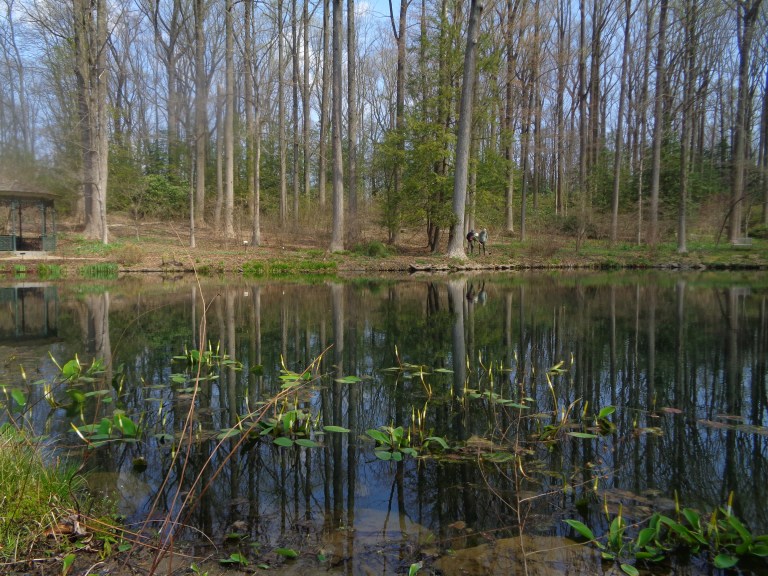


A bull frog lurking in the roots

Allegheny pachysandra. Fragrant


Wild geranium (geranium maculatum)


Creeping phlox and foam flower

Foam flower (Tiarella) in early April


Frasier’s sedge (Carex fraseriana)

Twin Leaf (Jeffersonia diphylla)


Celandine poppy


Schoaf’s Double Pink rue anemone (Thalictrum thalictroides)


Trillium flower in April

Southern Nodding Trillium

Large Toadshade trillium
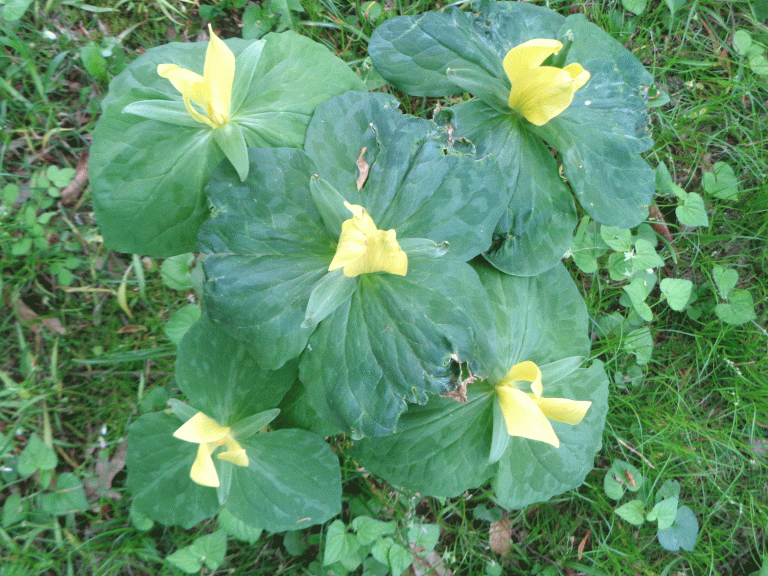


Great white trillium


Velvet trillium

Double Form Large-flowered Wakerobin


Red trillium


Hybrid trillium (Trillium flexipes x Trillium erectum)

Lanceleaf trillium
Quaker Ladies (Houstonia caeruleia) growing on moss in April and May


Bellwort (Uvularia perfoliata)


Jacob’s-Ladder (Polemonium reptans)

Purple phacelia (biennial flowering).
Photos from the website of Mt. Cuba Center


Dwarf (spring) larkspur (Delphinium tricorne)

Turkey beard (Xerophyllum asphodeloides: a slow-growing lily)


Varieties of Rue-anemone (Thalictrum thalictroides)


Columbine (aquilegia) in mid-May .


Wild columbine varieties (Aquilegia canadensis)

Bloodroot (Sanguinaria canadensis)
Poisonous; with an underground stem from which red dye used to be extracted


?Double flowered bloodroot?

Bleeding Heart (Dicentra)


Dutchman’s Breeches (Dicentra cucullaria)


Bishop’s cap (Mitella diphylla).
Black seeds shown in their receptacles in the photo above from the website of Mt. Cuba Center


?The immature flower of Fairy wand (Chamaelirium luteum)


Moss phlox (phlox subulata)

Spring Beauty (Claytonia virginica)


May Apple whose fruit grows at the juncture of two large leaves. It is poisonous until it is ripe


Marsh marigold (Caltha palustris)


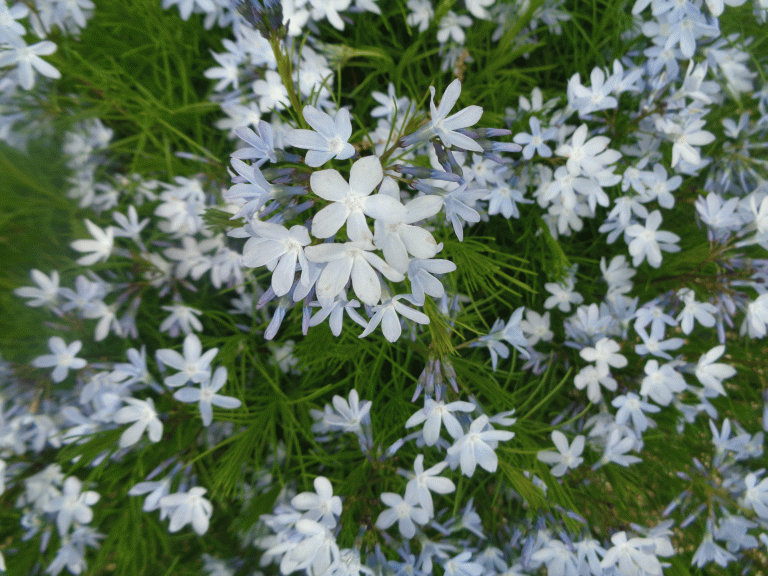
Fringed bluestar (Amsonia ciliata)
Large Yellow Lady’s Slipper (Cypripedium Calceolus) in May. A perennial, multi-stemmed orchid


Trout lily (Erythronium americanum)


Atamasco lily (Zephyranthes atamasca)


Large-flowered valerian (Valeriana pauciflora) with a swallow-tailed butterfly


Shooting star (Dodecatheon)


Golden ragwort


Forms of False indigo (Baptisia)


In late April, high canopy trees have begun to leaf and the native bushes to bloom
Trumpet Honeysuckle (Lonicera Sempervirens). Deciduous this far north


Native mid-level trees, redbud and native dogwood, are blossoming in mid April and early May.


Our eyes are directed upwards.


Blossom of Redbud
And the short ‘hour’ of most of the native ephemerals is done for another year.
Delicate miracles photographed with such skill. Thank you so much for the details that make all the difference to showcasing the plants’ distinctivenesses. And how ever do you know so many of the names!!!! A walking encyclopedia, I would say.
Thank you for your comment, Susannah.
Mt, Cuba is a teaching and research station for native flora. They label many of the plants and there are docents to answer questions. I have sent photos to their research staff and they have responded with the names of the plants I am asking about. The place is a veritable paradise………Sarah
Thank you very much for sharing these fabulous images and also providing the various names😍
A pleasure, Luisa!