
Georg Baselitz, 1938-2026, German
In the artist’s 80th year, 2018, the Hirshhorn Museum and Sculpture Garden (Smithsonian Institution) in Washington, DC mounted a second retrospective of the artist’s work. The first in the United States was in 1995 at the Hirshhorn and the Guggenheim in New York.
These works date from 1959 and represent the artist’s progression through six decades to 2017.
Born in East Germany, the artist moved to West Germany when he was 20 to study art. Trying to escape the Russian advance at the end of WW2, the artist and his family, trying to get to Bavaria but reaching only the outskirts of Dresden, saw the destruction of Dresden.
Early in his career, the artist committed himself to figurative art.

Baselitz in front of an exhibition poster and manifesto of Why The Great Friends is a Good Picture, 1966.
Photo taken by the artist’s wife and now in private collection
Impressionism did not interest him.
He condemned abstract expressionism – abstract painting being the most popular style when the artist began to paint.
Abstraction, the artist said, was an ‘escape’. By this it appears that he meant that abstraction was not equal to confronting the catastrophic state of Germany after WW2.
Baselitz, nevertheless, adopted the rough, gestural brushwork employed by some of the Abstract Expressionists. And he exempted Willem de Kooning (1904-1997, American born the Netherlands) from his condemnations. He admired de Kooning.

A gallery of the Hirshhorn, Washington DC, during the 2018 Baselitz retrospective


Win D., 1959, oil on canvas.
Georg Baselitz, German, 1938-2026. Private collection loan
The artist, Winfried Dierske, 1934-2006, was a friend of the artist and a member of the first group of artists who sought to work outside the constraints of East Germany’s mandated Social Realism
He seems to have been impressed by the scale of Jackson Pollock’s paintings. When he could afford it, he adopted large formats.
He published at least three manifestos. In these he explained his commitment to figurative art and his rejection of the abstract art dominant when he was young. He explained the tools in his artistic tool box.
Looking for artistic precedents outside the mainstream, the artist reviewed, among other currents, Art Brut, German Expressionism which had been condemned by the Nazis, and Dada.
Edvard Munch (1863-1944, Norwegian) was important to him. Likewise his contemporary, A.R. Penck (1939-2017, German).
His own work is referred to as ‘neo-Expressionist’ for its lively colour, rough brushwork, inexact outlines and lively emotion.
Baselitz never left his chosen figurative path.
Thrown out of art school in East Germany for not conforming with Social Realist expectations, he left for West Germany (the Wall had yet to be built).
There began his experiments: cutting figures into portions splayed across the screen; turning figures, objects upside down for more freedom of (his) action; experimenting with colour, format, rough brushstrokes; making drawings and prints; using photographs and sketches (after 1969). Painting with the canvas on the floor. Painting a subject repeatedly in a series. Revisiting subjects and portraits decades later. Making figurative sculpture.


Oberon (1st Orthodox Salon 64 – E. Neizvestny), and detail, 1964, oil on canvas.
Georg Baselitz, German, 1938-2026. Stadel Museum, Frankfurt am Main
He wanted, from young, he says, to stand out. He wanted to be the first in the history of the graphic arts to do this or that.
And he claimed this primacy for himself with his priapic paintings of figures with erect penises, like The Naked Man.

The Naked Man, 1962, oil on canvas.
Georg Baselitz, German, 1938-2026 Private collection
And with ‘negative’ paintings (they resemble photographic negatives) of recent years (not shown) where he compared his own work favourably with Andy Warhol’s silkscreened images.
And with his sculptures of the 1980s (below).


G. Antonin, 1962, oil on burlap, and canvas.
Georg Baselitz, German, 1938-2026. Private collection
Baselitz’ work is widely exhibited, has entered many private collections, and is very well-received. His paintings sell for millions.
And he seemed, from interviews given in connection with his 80th birthday, to be content with his achievements.


Tear Sac, 1963, oil on canvas.
Georg Baselitz, German, 1938-2026. Museum Frieder Burda, Baden Baden
The German woodsman of myth and memory took a large place in the artist’s oeuvre.
For him this was not merely a symbol. He was born and lived as a child in a small East German village. He was not only familiar with trees and forests but he wanted to be a woodsman. He passed his forestry exams at Germany’s most famous forestry school.

Red-Green One, 1965, oil on canvas.
Georg Baselitz, German, 1938-2026. Private collection
The hero woodsman of German memory and myth carrying the flag of sacrifice and survival.
Many have praised the ‘groundbreaking quality’ of the artist’s work from the 1970s onwards.
Particular focus has been on his Hero (Woodsman) series.


B.J.M.C. Bonjour Mosieur Courbet, and detail, 1965, oil on canvas.
Georg Baselitz, German, 1938-2026. Private collection.
I don’t know why Baselitz called on Gustave Courbet (French, 1819-1877). Here his great forbear – a man so invested in the politics of the day that he was imprisoned not long before his death – is sowing seed.


Man in the Moon, Franz Pforr, 1965, oil on canvas.
Georg Baselitz, German, 1938-2026. National Gallery of Art, Washington, DC
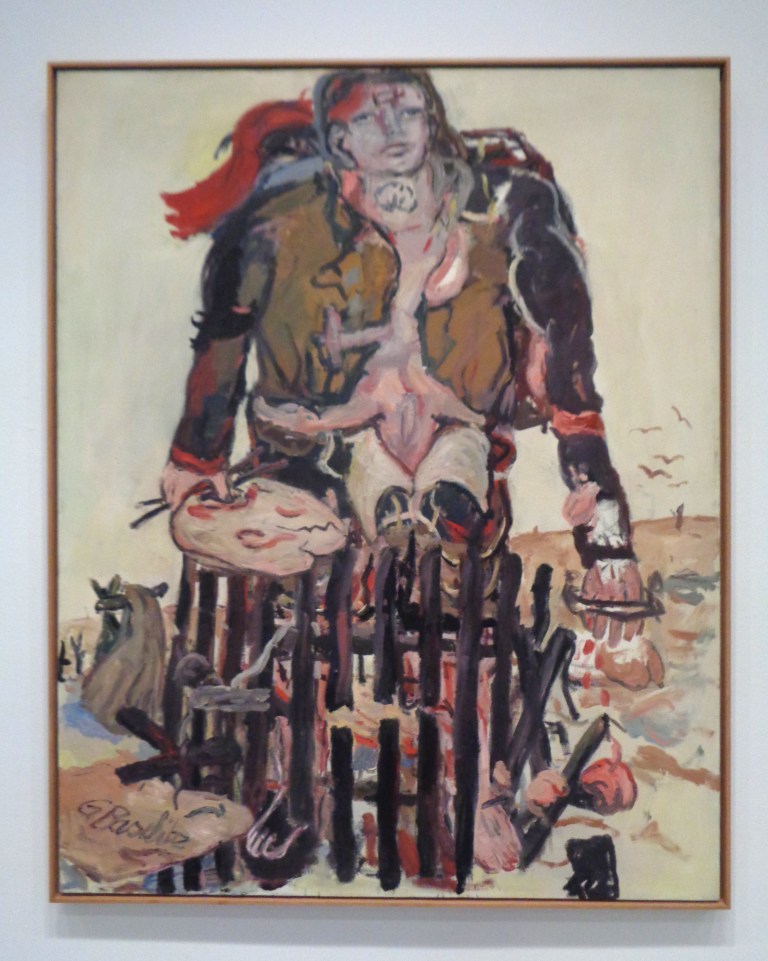

Various Signs, 1965, oil on canvas.
Georg Baselitz, German, 1938-2026. Fondation Beyeler, Riehen/Basel, Beyeler Collection
The hero woodsman of German myth and memory as artist, hedged in but moving forward nonetheless.
He painted perhaps 40 paintings on the subject of the Woodsman: men, often carrying red flags, always upright, looking unafraid, head up; but wearing tattered clothing and walking through a waste of debris.
Hero woodsmen of German myth and memory and (re)builders of the German nation.
These have been taken to represent the heroic capacity of the German people to survive and flourish despite the catastrophe of two world wars and their death-bearing ideologies.


Summer Morning, 1964, oil on canvas, and detail.
Georg Baselitz, German, 1938-2026. MKM Museum Kupersmuhle fur Moderne Kunst, Duisberg, Stroher Collection


The Whip Woman, 1964-65, and detail; oil, pencil, coloured chalk on canvas.
Georg Baselitz, German, 1938-2026. Museum Ludwig, Cologne
The artist has said that politics and politicians do not interest him except insofar as they made his work life difficult from time to time when he was younger.
Critics have interpreted paintings other than the Hero series as political statements. His salacious work as discontent with Germany’s socialist politics (1960’s). His fractured paintings as a commentary on the state of the German nation.
Despite this, his politics are not obvious in his overall oeuvre.
The artist said that it is market value which is the marker of an artist’s success.
This work seems to note the artist’s hope of inclusion among those of whom Clement Greenberg approved. Clement Greenberg, 1909-1994, the most influential critic of his day, accompanied the Abstract Expressionists on their revolutionary journey.


Greenberg Grins, 2013, oil on canvas
Georg Baselitz, German, 1938-2026


The Tree, 1966, oil and crayon on canvas.
Georg Baselitz, German, 1938-2026. Froehlich Collection, Stuttgart, Germany


A Workman, 1967, oil on canvas.
Georg Baselitz, German, 1938-2026. Metropolitan Museum of Art, NY
It seems that the artist has been first and foremost a man, linked at the heart to his country and its philosophical traditions; nevertheless working out his own salvation during a time of non-figurative, often eye-popping work.


Meissen Woodsmen, 1969, oil on canvas.
Georg Baselitz, German, 1938-2026. Hirshhorn Museum and Sculpture Garden
The hero woodsmen of German myth and memory carrying paintings.
Baselitz had a large sense of his own destiny and talent. He also was successful in explaining his thinking.
It helped also that he did not shy away from decisions which focused the spotlight on him:
painted erect penises calling down the prosecutorial wrath of the state (dismissed by the German Supreme Court) at his first solo exhibition in Germany;
withdrawal in the 1970s from Documenta in Kassel because it included representation from East German Social Realists;
a sculpture heiling Hitler;
and views on the art work of women which were shamelessly misogynistic and drew attention.
The artist spoke of the influence on him of his father’s brother, a Protestant pastor in Dresden. A man who took him in hand when he began to drift in adolescence. A man who showed him the work of artists. And a man who did not share his parents’ view that he had to follow a conventional education and to get a conventional job. Self-actualization, in other words, was the order of his uncle’s day for his nephew.
The artist spoke of some of the sources of his art: the ancient shards and pots he found in his childhood village; his interest in what is below us and is opaque to us.
His need to control his creations. His willingness to be an outsider. His will to survive his work beyond the period of a short-term wonder. His lack of interest in conventional politics and his disdain for conventional religion which he conceived as a vast entertainment system.


Da. Portrait (Franz Dahlem), synthetic resin on canvas, and detail.
Georg Baselitz, German, 1938-2026. Private collection
Upside Down
Early, Baselitz turned his work upside down. He also posed his figures in parallel flotations and pieced his canvases together in ways which are visible.
The artist explained that these are purposefully an irritant to the viewer: to force focus.
He also said that these methods were to encourage him to slow down. A telling statement given the lack of precision in his work: the slap-dash sensation one has when looking at his work (‘breathiness’).


Woodsman, 1969, charcoal and synthetic resin on canvas, and detail.
Georg Baselitz, German, 1938-2026. The Art Institute of Chicago
The hero woodsman of German myth and memory cut in half as was Germany in 1945
Upside down paintings give me a headache.

The multiply awarded Anglo-German translator, essayist and poet, Michael Hoffman, born 1957, in the galleries.

Still Life, 1976-77, oil on canvas.
Georg Baselitz, German, 1938-2026. MOMA, NY


Nude – Elke, 1974, oil on canvas.
Georg Baselitz, German, 1938-2026. Private collection
A figure or object seen upside down in figurative art without narrative reason loses its ballast, its perch, in a stable, recognizable network of things-in-the-world which speak to us.


Bedroom, 1975, and detail, oil and charcoal on canvas.
Georg Baselitz, German, 1938-2026. Private collection

Finger Painting – Apple Trees, oil on canvas; 1973.
Georg Baselitz, German, 1938-2026. Private collection


Fingerpainting – Eagle, 1972 , oil on canvas, and detail.
Georg Baselitz, German, 1938-2026. Bayerische Staatsgemaldesammlungen, Munich
The German eagle, stripped of its grandeur, crashing to earth.


Fingerpainting – Female Nude – 1972, and detail.
Georg Baselitz, German, 1938-2026. Louisiana Museum of Modern Art
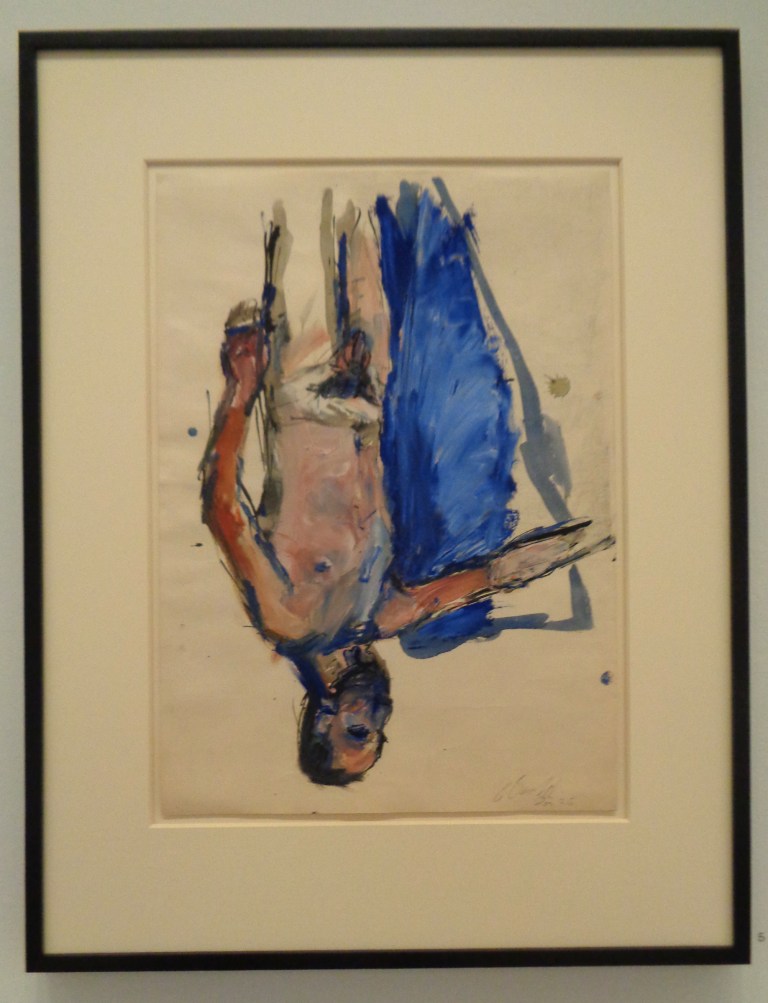

Untitled Nude with Wing, 1976, ink and oil paint on paper
Georg Baselitz, German, 1938-2026

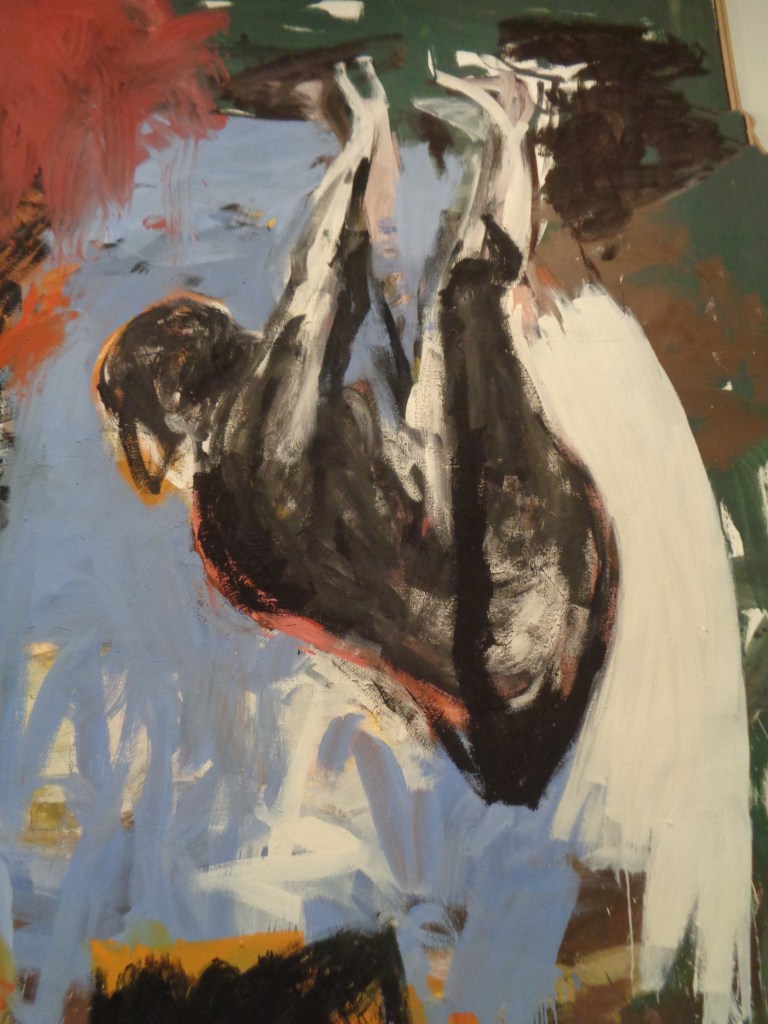
The Gleaner, 1978, oil and tempera on canvas, and detail.
Georg Baselitz, German, 1938-2026. Solomon R. Guggenheim, NY
Hanging upside down as though she were brachiating through tree branches. Unconvincing posture for a figure for whom the earth and its edible fruits, are everything.


Drinker with Glass, 1981, and detail, oil on canvas.
Georg Baselitz, German, 1938-2026. Private collection


Orange Eater I, 1981, and detail, oil and tempera on canvas.
Georg Baselitz, German, 1938-2026. Private collection

Orange Eater IX, oil and tempera on canvas.
Georg Baselitz, German, 1938-2026. Private collection


Away from the Window, 1982, oil on canvas.
Georg Baselitz, German, 1938-2026. Fondation Beyeler, Riehen/Basel.
A painting which recognizes the influence on his style of that of Edvard Munch, 1863-1944, Norwegian

Eagle in Bed, 1982, oil on canvas.
Georg Baselitz, German, 1938-2026. Private collection

Adieu, 1982, oil on canvas.
Georg Baselitz, German, 1938-2026. Tate Gallery, London

Adieu (Remix), 2006, oil on canvas.
Georg Baselitz, German, 1938-2026. Private collection
The artist has used a series of paintings to explore a subject. He has likewise revisited subjects years later and uses the word ‘Remix’ to denote a revisit.
Upside down positioning distinguishes this painter’s work in the tradition of Western figurative and representational art: a tradition which is coded, evolved, and freighted with meaning; and in which it is, now, difficult to make a significant artistic mark.
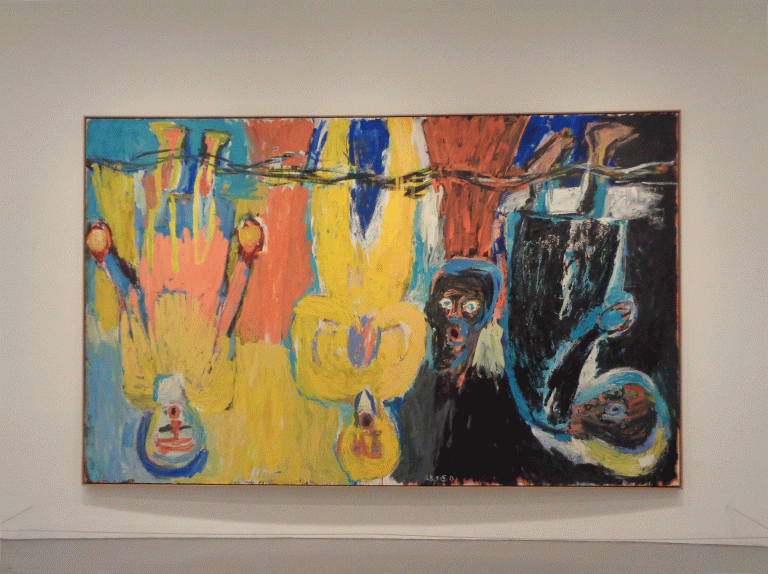


The Brucke Chorus, 1983, oil on canvas.
Georg Baselitz, German, 1938-2026. Private collection.
A recognition of the artist’s kinship with the German Expressionist group, Die Brucke, who moved away from traditional styles of painting towards a new mode of expression involving simplified, vibrant and distorted forms. A painting style condemned by the Nazis.


On the Right and Left a Church – Jorg, 1987, oil on canvas.
Georg Baselitz, German, 1938-2026. Private collection.
But we are no longer in figurative art when bodies and objects are hanging upside down for no narrative reason.
We are in a form of conceptual art. The artist was playing with an idea.


Picture Thirty-Four, 1994, oil and gold leaf on canvas, and detail.
Georg Baselitz, German, 1938-2026. Staatsgalerie Stuttgart
The artist often painted in series. This theme he repeated 39 times.
*********************************
Sculptures
In the 1970s, Baselitz began making sculptures and returned to them in the next decade.
These are directly carved with no modeling. The artist used chainsaw, chisel and axe.
The artist has described this sculpture as ‘unprecedented’. The museum made parallels with the ‘primitive art’ models which inspired Brancusi, Picasso and Die Brucke.
Only his fame, his talent for representing his work and the immense prices for which Baselitz’ works sell along with the investment of wealthy people and institutions in the maintenance of these prices encourage the evaluation of this work as as anything other than crude.


Untitled, limewood and oilpaint, 1982-83.
Georg Baselitz, German, 1938-2026. Tate Gallery, London


Ultramarine Woman, 2004, cedar and oil paint.
Georg Baselitz, German, 1938-2026. Courtesy of the artist and the Gagosian Gallery, NY


Zero End, 2013, patinated bronze, and detail.
Georg Baselitz, German, 1938-2026. Private collection courtesy of Gagosian Gallery, NY
Nor is it reasonable to think that the artist did not anticipate the howls which accompanied the display of the figure below at the 1980 Venice Biennale with its Hitlerian salute. It was this ruckus which first brought Baselitz to international attention.
1981 saw his first solo exhibition in New York.


Model for a Sculpture, 1979-80, limewood and tempera.
Georg Baselitz, German, 1938-2026. Museum Ludwig, Cologne
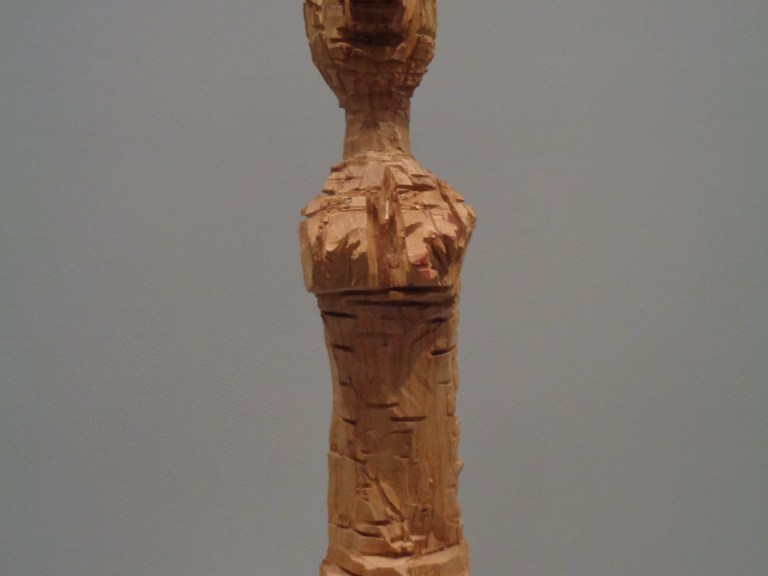

Tragic Head, 1988, and detail, birchwood and oil paint
Georg Baselitz, German, 1938-2026. Hirschhorn Museum and Sculpture Garden
****************************
I am not sure if the skill of the artist’s work until his late paintings is equal to the symbolic heft of the artist’s subject matter: the revival of the German civilization.

Man of Faith, 1983, oil on canvas.
Georg Baselitz, German, 1938-2026. Metropolitan Museum of Art, NY
It is clear that it was his tenacity in tackling this subject, his rejection of the aridity of the Minimalists, Conceptualists and Pop artists, along with his adroit representation of his own work, which propelled the artist out of the shadows.
Much of his work is immediately recognizable because the figures are upside down: an effective marketing technique.
Germany’s history from 1914 to 1945 (strictly from the 1871 reunification of Germany to the 1991 reunification of Germany) is a fate apart and he was addressing himself to this fate.
This artist chose to do this using the oldest, most evolved, most disciplined aesthetic tradition of his civilization: figurative art.


Ciao America I, 1988, oil on canvas, and detail.
Georg Baselitz, German, 1938-2026. Hirshhorn Museum and Sculpture Garden
A strange painting because of all creatures, the freest are birds.
Unless the artist is making a negative statement about the periodic self-imposed isolationism of the North American continent.
I don’t know why anyone would consider salacious paintings of aroused male figures to be be a milestone in the history of Western figurative painting. Or sculptures as unformed as this artist’s.
I have no doubt that a certain leeway has been accorded this artist for his long effort to engage the artistic powerful in Europe and North America. And he has been duly rewarded by them.
With Baselitz’ upside down routines, what remains on the retina is the upside downness.
The artist creator may have gained his own salvation. He may be in control and he may have retained his artistic agency.
But so many of us have a headache.
And, in this instance, pain is not gain: it is not clear that we have learned anything interesting from his upside down exercises.
Late paintings from 2000 onwards
In the early 1990s Baselitz’ work became more abstract: color and line are the focus.


Maria and Franz Marc, 2002, pencil and oil on canvas, and detail.
Georg Baselitz, German, 1938-2026. Private collection.
Franz Marc (1880-1916), a founding member of the avant-garde artistic group, The Blue Rider, was killed in WW1.

Far to the East, 2004, oil on canvas.
Georg Baselitz, German, 1938-2026. Private collection
There is a marked change in the style of the artist’s late work. He breaks away into a dazzling originality.
The impulse of this seems to be an effect of the artist’s ageing and the comforts of his immense critical and commercial success.

The Hand of God (Remix), 2006, india ink and watercolour paper.
Georg Baselitz, German, 1938-2026. Private collection


Big Night, (Remix), 2008, india ink and watercolour on paper.
Georg Baselitz, German, 1938-2026. Private collection
After 2000, the artist’s own, painted salvation has led in these last two decades to the most luminous paintings of human isolation and loss, human vulnerability, the tenacity of human persistence, belonging and connectedness.
The palette changes. The colours are lighter, in general brighter, less earthy (earthbound), more tentative; against a stark, dark background.
The canvas becomes vast. The figures no longer hostile to their environments.
A Modern Painter below marks the change in style.
Here is the hero woodsman of German myth and memory, in clear multi-colours, lifted up on his forest platform, his eyes looking upwards.

A Modern Painter (Remix), 2007, oil on canvas
Georg Baselitz, German, 1938-2026
The Hirshhorn noted (but did not display) that the artist embarked, in 2010, on a series of nude paintings of his wife, Elke Kretschmar: not infrequently the subject of his paintings when they were younger. They married in 1962 and she survives him at his death in 2026.
The artist spoke of the fragility of old age and the inevitable turn to mortality.


Artaud (Remix), 2007, oil on canvas.
Georg Baselitz, German, 1938-2026. Gagosian Gallery
When I saw these late paintings, suddenly it was immaterial to me if these bodies are upside down, sideways or slung from the rafters.
My headache evaporated in an instant.
In these paintings, metaphor is queen. Metaphor is a powerful language in which a is b. Not like b. Is b.
A transformation in which the reality as we have described it (and probably stymied ourselves) is overtaken by the imaginative faculty which transmutes what we ‘know’ into changed ways of seeing and understanding and being in the past and the present; and sensing (hoping for) the future.
The artist has also used late paintings to recall and rework memories of his war years; and memories of friends of whom he had made portraits when younger.

Fällt von der Wand nicht (Doesn’t Fall From the Wall) – posted to the web. Photos taken by Jean-Pierre Dalbera.
Georg Baselitz, German, 1938-2026. 3 of 8 paintings shown at the Venice Biennale in 2015. Now in the possession of Henry Pinault.
Beginning the artist called this work.


Beginning, 2011, oil on canvas, and detail.
Georg Baselitz, German, 1938-2026. Private collection.
Metaphor is among the most precious of Sapiens’ tools to survive the difficulties of human life and the unpalatable inevitablity of death.
The artist equated bodies with stars and planets and human relationships with astral maps.
With that of our sun: molten hot and streaming flares.
With pale pink-sepia stars cooling after the explosion of their birth.
With moons which, without light sources of their own, reflect in brilliant silver-grey-white the light of their suns.
With planets which have cooled to frozen rock-grey.
With black holes.
The artist’s painted figures are not like galaxies, sun, planets, moons. They are the sun, the stars, the planets of our galaxy.
The woodsman is the tree which is Germany revived.


A Green One, Kaput ’67 (Remix), 2007, oil on canvas, and detail.
Georg Baselitz, German, 1938-2026. San Francisco Museum of Modern Art
The heroic woodsman of German myth reimagined as tree.


Dystopian Couple, 2015, oil on canvas.
Georg Baselitz, German, 1938-2026. Courtesy of the artist and White Cube


I’ve had this surreal tendency for a while now, 2010, oil on canvas and detail.
Georg Baselitz, German, 1938-2026. Private collection


Who All? What All?, 2016, oil on canvas and detail.
Georg Baselitz, German, 1938-2026. Private collection
The genesis of this painting is a 1924 portrait by Otto Dix, 1891-1969, of his parents. Dix’s work was condemned by the Nazis.


Downward for the Moment, 2017, oil on canvas.
Georg Baselitz, German, 1938-2026. Private collection
The museum noted that this painting is based loosely on Marcel Duchamp’s Nude Descending a Staircase.
Baselitz has transformed the nude into two figures who have become ethereal, and are, in late age, moving downwards.
Of course, the painting is upside down and perhaps the two are rising.
Here is the artist well advanced on a journey which began in the destruction of his homeland to arrive, bit by bit, at his identification with our universe(al) of a homeland.
We’re off he says in the work below.


We’re Off, 2016, oil on canvas
Georg Baselitz, German, 1938-2026. Private collection


Rosa E., 2017, oil on canvas
Georg Baselitz, German, 1938-2026. Private collection, Stockholm
A reworking of an earlier portrait.


Dierske, 2017, oil on canvas.
Georg Baselitz, German, 1938-2026. Private collection
A reworking of a portrait which the Museum suggested indicates a tension between the facts and the artist’s memory.
One could equally say that the artist has held his friend, whose 1959 portrait is above, close for approaching six decades
A change of palette, an adoption of near-abstraction, a conceptualization of Man as a being not of this earth alone but of the universe, a burst into the universe and into universal themes, vast canvases, a painted affirmation of the place of Sapiens in his/her vastest homeland.

A view of an exhibition in 2025. Dmitry Kostyukov for The New York Times
A homeland which we cannot destroy.
Wonderful works and, for all that death hovers, heartening for the acceptance that we belong not to warring nation states in an endless cycle of destruction and renewal but to a much vaster natural reality not subject to human proclivities.

A late photo of the artist in his studio. Photo from the web
<3