
Robert Rauschenberg, 1925-2008, American, painter, multi-media sculptor, printmaker, performer, set-designer
from exhibitions at the MOMA, NY in 2017: Rauschenberg: Among Friends
and at the Solomon R. Guggenheim, NY in 2026: Life Cannot be Stopped
MOMA, NY reviewed the art of Robert Rauschenberg in 2017 with a representative sample of the artist’s large oeuvre. The Guggenheim, NY this year expanded the showing.
The focus at MOMA was on the artist’s close co-operation with colleagues and friends, arts communities inside and outside the United States.
A Texan by birth, Rauschenberg enlisted in the navy in 1944 when he was 19 or 20. He was not sent into a foreign theater of war. He worked at a Marine Corps. rehabilitation center before school in the arts in the United States and at the Académie Julian in Paris.

Postcard, Self-portrait, Black Mountain (North Carolina, where the artist was at art school),
1952, silver gelatin print.
Robert Rauschenberg,1925-2008, American. Photo from the website of the Robert Rauschenberg Foundation


Autobiography, 1968, 3 lithographs, edition of 2000
Robert Rauschenberg, 1925-2008, American. Solomon R. Guggenheim, NY
The artist’s full body X-Ray, overlaid with his astrological chart. The second panel details key moments of the artist’s life and artistic life printed over a snapshot of the artist and his family, boating.
The third panel is the artist on the roller-skates he used in a 1963 performance of Pelican. On one side, a NY skyline and on the other a navigational chart of the Gulf of Mexico off his natal town, Port Arthur, Texas.
The artist was in New York by 1949.
Rauschenberg met and travelled with Cy Twombly (1938-2011, American) in the early 1950’s.
He also had a 10-year co-operative relationship with Merce Cunningham (1919-2009, American choreographer)
and John Cage (1912-1992, American composer) both of whom he met when studying under Josef Albers (1888-1976, German artist and educator) at Black Mountain College in North Carolina.
In New York he met Jasper Johns (American born 1930) in 1954. Johns is the most celebrated of his colleagues and undoubtedly the closest as they began their careers.
The two of them, with Andy Warhol, put paid to the hegemony of the men of Abstract Expressionism who had strict rules about what you could and could not represent; and how. And women were all but excluded.
Paying no heed to the strictures of Abstract Expressionism, both Johns and Rauschenberg took to the philosophy of Marcel Duchamp (1887-1968, American born France)
and set their own minds and imaginations as the limit of what they could create. They kept counsel with each other’s ideas until 1961 and then went their separate ways.

Bottle Rack, 1960 (third version after the original of 1914 was lost), galvanized iron.
Marcel Duchamp, 1887-1968, American born France.
Robert Rauschenberg Foundation.
The museum noted that Rauschenberg bought this for $3 dollars when he saw it in an exhibition called Art and the Found Object in which his own work was also exhibited.
Marcel Duchamp inscribed the rack at Rauschenberg’s request; and the artist kept this in a place of treasured objects in his studio for the rest of his life.
The importance of Rauschenberg’s work and that of Jasper Johns is to have expanded the means, motifs, and intent of artistic expression.
Artistic expression, taken out of the self-referential clubs of of a small group of men and pushed out into the world on clouds of imagination and experimentation.
Jasper Johns is about the philosophical question of what makes something art.
Rauschenberg was as interested as is Johns in the status of ordinary objects when an artist uses them. He turned himself to the world. He said that he wanted to inhabit the space between art and life.
Jasper Johns, who has never discussed his work and discourages the search for meaning in his work, turning inwards, has incessantly worried away by repeating again and again, with the most disciplined techniques, his treatment of a small group of objects from different angles or using different media.


Grand Black Tie Sperm Glut, 1987, riveted street signs and other metal parts.
Robert Rauschenberg, 1925-2008, American. Loaned by the Rauschenberg Foundation to MOMA, NY in 2017.
The museum noted that the artist made this work, one of several in a ‘Glut’ series, in a reaction to the recession in his native state, Texas where a glut in the oil market threw the state into a deep recession.
The artist is noting that the way forward is obscure.
It is 40 years later and nothing has changed about our And that there is violence of a deathly kind in the economy.
Rauschenberg’s work is almost beyond description for the range of it.
His world is multifarious, multidimensional, multi everything and a place for our thoughtful interaction and imaginative expression.
In the summer of 1970, joining a protest movement in the arts against the Vietnam War, Rauschenberg withdrew from the U.S. Pavilion at the Venice Biennale.
His political concerns brought him eventually to a personal commitment to show how art can create the conditions for peace internationally, of co-operation; and how art can highlight the urgency for social justice.
We are always with Rauschenberg for this reason and also for the great skill and gorgeousness with which he incorporated our lives into his life’s work.
Sensual embrace
Rauschenberg’s charm amounting to charisma has often been noted.
Sensuality is probably a large component of charisma and it is sensuality which streams out of photographs and his work; and the enthusiastic handling of his paint and of the many substances he used.
Merce Cunningham‘s dancers spoke of the pleasure they had feeling and dancing their way through and around one of Rauschenberg’s dance sets.
Much of Rauschenberg‘s art is sensual.


Canyon and detail, 1959, oil, pencil, paper, photograph, fabric, wood, canvas, buttons, mirror, taxidermied eagle, cardboard, pillow, paint tube, and other materials.
Robert Rauschenberg, 1925-2008, American. MOMA, NY
The bald eagle was a gift from the artist Sari Dienes (1898-1982, American) who found it in a pile of discarded stuff in a building in New York. The photograph is of Rauschenberg’s son, Christopher.
A depiction of the homeoerotic desire in the myth of Zeus and the boy Ganymede whom he kidnapped and lifted to his Olympian abode is one of the sources of this combine also.
A fabulous painting, sensuous and sober, of the acceptance by an American artist of his destiny and of himself as he was.


Painting with Grey Wing and detail, 1959, oil, printed reproductions, unpainted paint-by-number board, typed print on paper, photographs, fabric, stuffed bird wing, and dime on canvas.
Robert Rauschenberg, 1925-2008, American. The Museum of Contemporary Art, Los Angeles loan to MOMA, NY in 2017
A depiction of the homoerotic desire in the myth of Zeus and the boy Ganymede whom he kidnapped and lifted to his Olympian abode.


Ace, 1962, oil, paper, paint can label, umbrella, doorknob, wood, fabric, nails, and metal on canvas.
Robert Rauschenberg, 1925-2008, American. Albright Knox Art Gallery on loan to MOMA, NY in 2017.
Ace was the artist’s name for the dancer and choreographer, Steve Paxton, 1939-2024, American
Generosity
Rauschenberg’s generosity was comprehensive. In 1966, he co-founded an organization to promote exchanges between artists and engineers.
Four years later he founded Change, a nonprofit organization to assist artists-in-need with emergency expenses.
His generosity was of the spontaneous kind.
The Moderna Museet in Stockholm reports an incident in which a woman who did not know the artist dismissed a painting in his presence as something that a boxer she named could have done. The artist immediately moved to the painting and wrote that the creation was that of the boxer.
The artist spoke of the generosity of objects which he found and incorporated into his work:
earth substances, ambient and generated sound, found objects and manufactured items.


Black Market and detail, 1961, oil, watercolour, pencil, paper, fabric, newspaper, printed paper, printed reproductions, wood, metal, tin, street sign, license plate, four metal clipboards on canvas, with rope, chain and metal suitcase containing rubber stamp, inkpad and typed instructions regarding objects to be given and taken by viewers.
Robert Rauschenberg. Loan to MOMA, NY by Museum Ludwig, Cologne in 2017
Exhibited first in Amsterdam in1961, Rauschenberg placed objects in the metal suitcase and had an invitation to visitors to take an object and replace it with something of their own and place a drawing of their contribution on one of the clipboards.
He withdrew the invitation when it was found that people were stealing the objects in the box and contributing nothing.
Materials
He transferred images onto reflective materials such as steel and aluminium.

Untitled (Night Blooming), 1951, oil on canvas with embedded gravel, asphaltum and lead paint.
Robert Rauschenberg, 1925-2008, American. Loaned to MOMA in 2017 by his foundation
He also used biodegradable and vegetal dyes in the many textile-based designs he made.

Gold and silver leaf on fabric, newspaper, paint, wood, glue and nails on wood in a wood and glass frame, 1953.
Robert Rauschenberg, 1925-2008, American. Robert Rauschenberg Foundation loan to MOMA, NY in 2017

Gold Leaf on fabric, and glue on composition board in a wood and glass frame, 1953.
Robert Rauschenberg, 1925-2008, American.


Mother of God and detail, c. 1950, cut and torn roadmaps with newspaper, oil, enamel, and metallic paint on Masonite.
Robert Rauschenberg, 1925-2008, American. San Francisco Museum on loan to MOMA, NY in 2017
The museum noted that the artist made a number of ‘elemental’ paintings to showcase a particular material: paper, gold, dirt, clay.
In order to ‘test the market’, the artist also made paintings of toilet paper for each painting he made of precious metal. These last have not survived.

Untitled, 1959, tin can, pocket watch, and chain.
Robert Rauschenberg, 1925-2008, American. Private loan in 2017 to MOMA, NY

Mud Muse, 1968-71, bentonite mixed with water in aluminum and glass vat with sound-activated compressed-air system and control console.
Robert Rauschenberg, 1925-2008, American. Loaned to MOMA in 2017 by the Robert Rauschenberg Foundation.
This work comprises a feedback loop which the artist created with aerospace engineers from Teledyne. The sounds seem primordial. The technology is modern.
The museum noted that the basin of this vat is filled with bentonite normally used when drilling natural gas and oil wells. There are sound-activated pneumatic tubes installed in its base which pump air through the mud in response to a tape recording of the sounds of the bubbling clay.

Untitled, 1974, solvent transfer and watercolour on cheesecloth with paper
Robert Rauschenberg, 1925-2008, American. Solomon R. Guggenheim, NY

Easter Lake (Galvanic Suite), 1988, silkscreen ink, enamel, and acrylic paint on galvanized steel
Robert Rauschenberg, 1925-2008, American. Robert Rauschenberg Foundation loan to the Solomon R. Guggenheim, NY in 2026
The artist’s techniques were many:
Photography was an early and abiding interest.
He painted, sculpted, used collage and also lithography, metalworking, silk screening, and digital printing. He designed sets.
Rauschenberg’s painting techniques included the peremptory brushwork and dripping, dribbling, scraping, splashing and the gorgeous colours of the Abstract Expressionists.
Black, white, and red paintings
Between 1951 and 1953, Rauschenberg created monochrome white and also black paintings using newspaper.

White Painting, 1958, repainted 1968, seven panels painted with Latex house paint, roller and brush.
Robert Rauschenberg, 1925-2008, American. Robert Rauschenberg Foundation loan to MOMA, NY in 2017


Untitled, enamel paint and and paper on canvas, 1951. 4 parts.
Robert Rauschenberg, 1925-2008, American. Whitney Museum of American Art loan to MOMA, NY in 2017.
This is one of six black paintings which the artist reworked to a size larger than the original to match sizes being produced by the Abstract Expressionists.

Untitled, 1952/53, oil and newspaper on canvas affixed to screen door.
Robert Rauschenberg, 1925-2008, American. Private collection loan to MOMA, NY in 2017

Detail of Untitled (Black Painting with Asheville Citizen), c. 1952, asphaltum and newspaper on oil and metallic paint on canvas. 2 panels
Robert Rauschenberg, 1925-2008, American. MOMA, NY
The museum notes that beneath the surface of asphaltum are a seated man and the bust of a woman. The original appears to be work done by the artist and Susan Weil and overpainted by Rauschenberg. Rauschenberg was not sentimental about old work because he recognized that he was in a process of education.
A third layer is provided by people circulating in the gallery and looking at this work.
In 1953, Rauschenberg also created red paintings.
The two pieces of wood above and below the creation below is an early take on the artist’s celebrated ‘combines’, begun in 1954.

Untitled (Red) Painting, c.1953-54, oil, fabric, newspaper on canvas, with wood
Robert Rauschenberg, 1925-2008, American. Solomon R. Guggenheim Museum, NY
Rauschenberg’s White Paintings, black too, were much reproduced by other painters including Cy Twombly and Brice Marden (American born 1938).
And by Ad Rheinhardt who reduced his own black painting in 1963 to a death knell for the end of the painted tradition. Something belied by the achievement of Rauschenberg and all his heirs after that date.

Ultimate Painting, 1963, oil on canvas.
Ad Rheinhardt, 1913-1967, American. Collection of Virginia Dwan on exhibition in 2016 at the National Gallery of Art, Washington, DC
Combines (1953-1964) were the artist’s name for his combination of sculpture, painting, collage and found objects and structures.
Perhaps the liveliness and popularity of his 170 combines come from the artist’s belief in the agency of non-organic objects. Not symbolic agency necessarily but agency because each has its history of human interaction.
After the eclecticism, the interiority, the gate-keeping and score-keeping of the Abstract Expressionists, Rauschenberg blew open the artistic field for good and also, of course, for derivative and imitative.
The art historian Leo Steinberg said, “What he invented above all was…a pictorial surface that let the world in again.”


Charlene, 1954, mixed media.
Robert Rauschenberg, 1925-2008, American. Stedelijk Museum, Amsterdam loan in 2017 to MOMA.
The artist wanted the world in his paintings: he included a number of real objects, some of them possessions like the T-shirt in this painting.
This tableau is the largest of the artist’s works in his ‘Red Painting’ series and is considered the first of his combines.

Satellite, 1955, oil, fabric, paper and wood on canvas with taxidermic pheasant.
Robert Rauschenberg, 1925-2008, American. Whitney Museum of American Art, NY


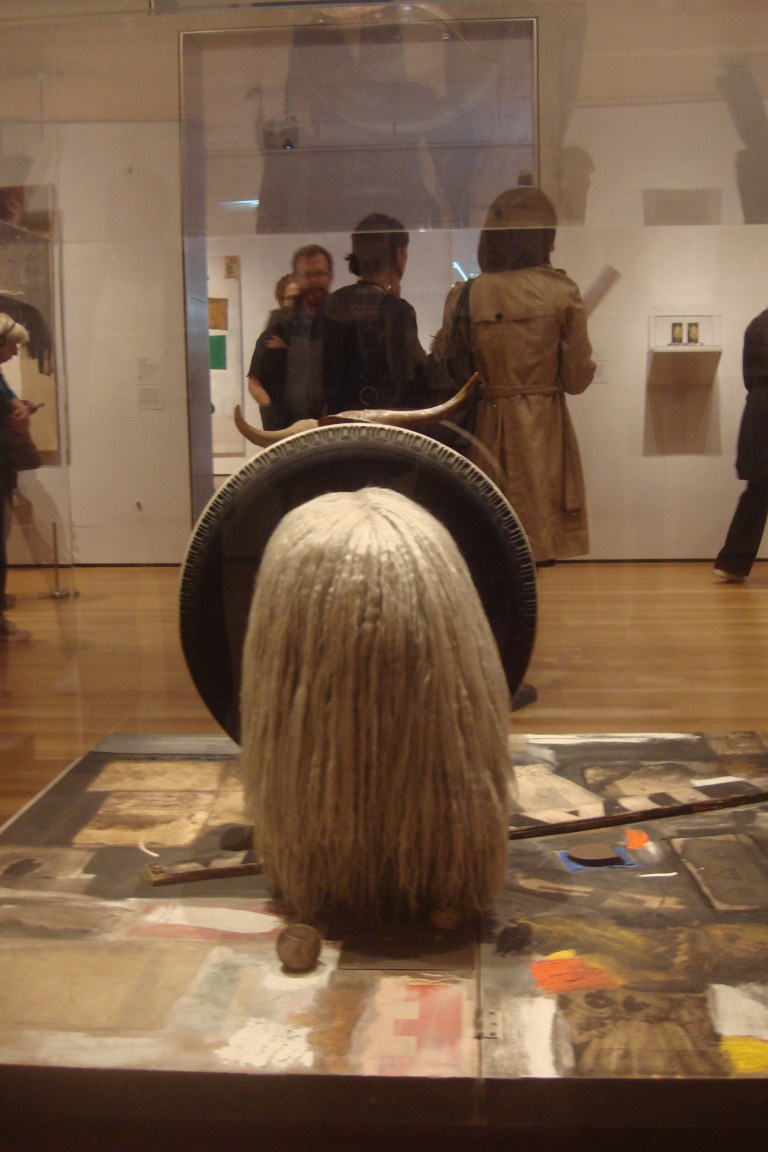
Monogram, 1955-59, oil, paper, printed reproductions, metals, wood, rubber shoe heel and tennis ball on two conjoined canvases with oil, an Angora taxidermied goat with brass plaque and rubber tire on wood platform mounted on four casters.
Robert Rauschenberg, 1925-2008, American. Moderna Museet, Stockholm loaned to MOMA, NY in 2017.
It was four years of experimentation for the artist before he decided, with the advice of Jasper Johns, to let him just stand there on his canvas with the tire around his middle. his tire.
There are many interpretations of this work.
I like that it juxtaposes our natural and fabricated worlds, our very rich milieu. I don’t like that this goat is constrained but then we constrain animals in order to consume them. We constrain animals in zoos. Animals are dying because of the detritus we have let loose in the world.


Pilgrim, 1960, oil, graphite, paper, printed paper, and fabric on canvas, with painted wooden chair.
Robert Rauschenberg, 1925-2008, American. Loan by a private collector to MOMA, NY in 2017
The museum notes that Merce Cunningham carried a chair on his back in his Antic Meet of 1958 and that may be a source of this combine. Jasper Johns has also real chairs in his work.
This chair was used to scrape paint down the painting. In his ever generosity, the artist is inviting you to sit with this work.


Gift for Apollo and detail, 1959, oil fragments of a pair of men’s pants, necktie, wood, fabric, newspaper, printed paper, and printed reproductions on wood with metal bucket, metal chain, doorknob, L-brackets, metal washer, nail, cement and rubber wheels with metal spokes.
Robert Rauschenberg, 1925-2008, American. The Museum of Contemporary Art, Los Angeles loan to MOMA, NY in 2017.
The artist acknowledged his antecedents to include the god Apollo. The museum noted that the god’s chariot has been reimagined and that the artist liked to add wheels to his combines in order to move them around.
Black Market and detail, 1961, oil, watercolour, pencil, paper, fabric, newspaper, printed paper, printed reproductions, wood, metal, tin, street sign, license plate, four metal clipboards on canvas, with rope, chain and metal suitcase containing rubber stamp, inkpad and typed instructions regarding objects to be given and taken by viewers.
Robert Rauschenberg, 1925-2008. Loan to MOMA, NY by Museum Ludwig, Cologne in 2017
Exhibited first in Amsterdam in 1961, Rauschenberg placed objects in the metal suitcase and had an invitation to visitors to take an object and replace it with something of their own and place a drawing of their contribution on one of the clipboards.
He withdrew the invitation when it was found that people were stealing the objects in the box and contributing nothing.
Performance was also a part of the artist’s repertoire.
Rauschenberg painted First Time Painting, below on stage, its back to the audience, and attached contact microphones to amplify the sound of his brushstrokes.
It was a part of Homage to David Tudor (1926-1996), the American composer closely associated with John Cage and Merce Cunningham.
The performance was installed by a collective of artists including Robert Rauschenberg, Niki de Saint Phalle, Jasper Johns, and Jean Tinguely at the American Embassy in Paris in June, 1961.
Rauschenberg was on stage, his canvas’ back to the audience. Microphones attached to the canvas allowed the audience to hear each brushstroke.
He declared the painting done when the alarm clock rang: an allusion to the difficulty of deciding when a painting is complete.
The artist wrapped the painting and left the theater. The painting was put on display the next day in a commercial gallery.


First Time Painting,1961, oil, paper, fabric, sailcloth, plastic exhaust cap, alarm clock, sheet metal, adhesive tape, metal springs, wire, and string on canvas.
Robert Rauschenberg, 1925-2008, American.
Jasper Johns signaled the program’s intermission by carrying his painting Entr’acte onto the stage.

15 Entr’acte (Fifteen-minute intermission), 1961.
Jasper Johns, American born 1930. Music Ludwig, Cologne on loan to MOMA, NY in 2017


Shooting Painting American Embassy, 1961, paint, plaster, wood, plastic bags, shoe, twine, metal seat, axe, metal can, toy gun, wire mesh, shot pellets, and other obects on wood.
Niki de Saint-Phalle, 1930-2002, French. MOMA, NY
A sharpshooter punctured bags of paint which dripped all over her painting.
Stage design, lighting and costumes
Rauschenberg worked for 10 creative years with the choreographer, Merce Cunningham and the composer John Cage.
For them and for others, Rauschenberg created stage design, lighting and costumes.


Minutiae and detail, 1954, oil, paper, fabric, newspaper, wood, paint sample colour chart, graphite, metal, plastic, with hanging mirror and wooden supports.
Jasper Johns, American born 1930 with Robert Rauschenberg. Private collection in Switzerland on loan to MOMA, NY in 2017.
This was built by the two artists at the request of Merce Cunningham who wanted something that his dancers could use in a dance. When the curtain went up, the mirror would be spinning and flashing.

Screenshots of Travelogue, a 1977 ballet: choreography by Merce Cunningham, score by John Cage to include bird sounds and dialed telephone numbers. The set design and costumes were by Robert Rauschenberg.
The set consisted of a row of chairs, bicycle wheels and hanging banners. During the dance, various items were appended to the dancer’s leotards. These included tin cans whose sound accompanied each move.


Scanning, 1963, oil and silkscreen ink print on canvas.
Robert Rauschenberg,1925-2008, American. Private loan to MOMA, NY in 2017
This includes images of members of Merce Cunningham’s dance group rehearsing Aeon. The paw marks on the left are those of Rauchenberg’s pet kinkajou whose name was Sweetie.
The company of his peers
Rauschenberg worked in companionship with many artists: sharing studios when he was young, and ideas, work techniques. He worked with choreographers and dancers.
Among artists who shared with him some portion of their work lives was Susan Weil, (American born 1930) whom he married and with whom he had a son before he fully assumed his homosexuality. Their mutual care and work encouragement continued throughout Rauschenberg’s life.
Their son runs the Rauschenberg Foundation.

Female Figure, c. 1950, exposed blueprint paper.
Susan Weil , American born 1930, and Robert Rauschenberg. Robert Rauschenberg Foundation

Sue, c. 1950, exposed blueprint paper.
Susan Weil , American born 1930, and Robert Rauschenberg. Private collection loan to MOMA, NY in 2017
He made art with as many techniques as he could master on a vast array of subjects.
Rauschenberg said: I think a painting is more like the real world if it is made out of the real world.

Untitled (Double Rauschenberg), c. 1950, exposed blueprint paper.
Susan Weil, American born 1930, and Robert Rauschenberg. Loan by the Cy Twombly Foundation to MOMA, NY in 2017


Short Circuit, mixed media, 1955.
This was created by Robert Rauschenberg with Jasper Johns (American, born 1930), Susan Weil (American, born 1930), Elaine Sturtevant (1924-2014, American).
It includes a program from an early John Cage concert given by David Tudor; and an autograph of Judy Garland.
The short circuit of the title refers to an invitation by Rauschenberg to friends to contribute works to this piece once he discovered that the gallery for whom this piece was made was not accepting individual works from his co-artists.
Susan Weil and Jasper Johns were, in the end, the only two to contribute their own drawings to this piece and these were incorporated by Rauschenberg within the shallow cabinets (Johns’ flag later stolen).


Bed and detail, 1955, oil, pencil, toothpaste and red fingernail polish on pillow quilt; and bedsheet mounted on wood supports.
Robert Rauschenberg, 1925-2008, American. MOMA, NY.
The artist made this when he did not have the money for a canvas. He used a quilt given him by the artist Dorothea Rockburne (American born Canada, 1932).
Cy Twombly, who often worked with Rauschenberg at this time in his NY studio, is thought to have added the pencil marks on the pillow.

Untitled Drawing, 1954, gouache, wax crayon and coloured pencil on paper.
Cy Twombly, 1928-2011, American. MOMA, NY
MOMA juxtaposed this drawing by Cy Twombly.


Rebus,1955, oil, synthetic polymer paint, pencil, crayon, pastel, paper paint chips, printed and painted paper, newspaper, journal, poster clippings, drawing by Cy Twombly, and fabric on canvas, mounted and stapled to fabric. Three panels.
Robert Rauschenberg, 1925-2008, American. MOMA, NY
The artist incorporated in this work a number of things which he found in a period of a few days in his neighbourhood. Colour discipline is provided a strip mid-painting of 117 commercial paint samples. A painting by Cy Twombly is included in the lower panel.
The title of the painting is the name of a game in which words and pictures can be used interchangeably. The museum notes that the artist believed the name to be an integral element of a work.
Silkscreen
In 1962, Andy Warhol taught Richard Rauschenberg how to use silkscreen. This coincided with a decision of Rauschenberg’s to incorporate ‘current world-wide images’ in a painting also containing ready-mades.
Rauschenberg created an inventory of more than 150 screens, combining and recombining their images and adding paint. For this he won the Venice Biennal in 1964.
The artist then called a friend in New York to destroy his screens in order to avoid the temptation to repeat himself in the wake of enormous attention and pressure following his acceptance of the 1964 Venice Biennial prize.
He continued, however, to use transfer techniques throughout his life to incorporate photography imagery in his work.


Let us Now Praise Famous Men (Rauschenberg Family) and detail, 1962, silkscreen-ink print on canvas.
Andy Warhol, 1928-1987, American. National Gallery of Art, Washington, DC on loan in 2017 to MOMA, NY
The museum noted that Andy Warhol asked Rauschenberg if he would make a portrait of him. This is the result made from one of several photographs dating from the 1920s and 30s of members of Rauschenberg’s family in Port Arthur, Texas.
Warhol’s title comes from a celebrated 1941 book of photos of the Depression in the south of the US of James Agee and Walker Evans. Rauschenberg was not famous in 1968 and the title is taken as expressing Warhol’s regard for him.


Persimmon and detail, 1964, oil and silkscreen-ink print on canvas.
Robert Rauschenberg, 1925-2008, American. Private collection loan to MOMA, NY in 2017.


Tracer, oil and silkscreen-ink print on canvas, 1963.
Robert Rauschenberg, 1925-2008, American. The Milton-Atkins Museum of Art, Kansas City, Missouri on loan to MOMA, NY in 2017


Barge, 1962-63, silkscreen and oil on one canvas measuring 32′
Robert Rauschenberg, 1925-2008, American. Guggenheim Museums
This represents the unending and random visual stimulation of the daily life which the artist loved. The images, from popular magazines, are those he used again and again. He also used his own photographs.


Details of Barge, 1962-63, as above


Cove, 1963, oil and silkscreen-ink print on canvas.
Robert Rauschenberg, 1925-2008, American. Loaned by Jasper Johns to MOMA, NY in 2017


Retroactive I, 1964, oil and silkscreen-ink on canvas.
Robert Rauschenberg, 1925-2008, American. Wadsworth Athenaum Museum of Art in Hartford, Connecticut loan to MOMA, NY in 2017
The artist made 7 canvases based on this image of President Kennedy during a presidential election debate with Richard Nixon.
He had a great admiration for John F. Kennedy’s deportment and actions in office.
Captiva, Florida
Rauschenberg first left New York in 1962 to get away from the pressure. He went to Treasure Island near St. Petersburg, Florida and kept his New York studio.
From 1968 and for 38 years until his death, Robert Rauschenberg lived on the island of Captiva off the west coast of Florida. There he established workshops with a print center at its center. He continued to work with found materials.
With his customary generosity, Rauschenberg invited others to join him on the island to make work. In the first year, five did that including Susan Weil and Brice Marden.


Sor Aqua (Venetian) and detail, 1973, wood and metal suspended with rope over water-filled bathtub with glass jug.
Robert Rauschenberg, 1925-2008, American. The Museum of Fine Arts, Houston loan to MOMA in 2017.
The artist returned to Venice in 1973. This work is one of several he made to recall, with the bathtub, the canals; and with the rusting metal above the bathtub, the deteriorated, aging surfaces of Venice.

Glacier (Hoarfrost), 1974, solvent transfer on satin and chiffon with pillow.
Robert Rauschenberg, 1925-2008, American. Loaned by the Menil Collection, Houston to MOMA, NY in 2017

Polar Glut, 1987, riveted metal street signs.
Robert Rauschenberg, 1925-2008, American. Promised gift to MOMA, NY.
Outside the US
Throughout his life, Rauschenberg travelled for his work, often including in his work materials he found. Often he worked with local artists.

Vow (Jammer), 1976, sewn fabric and rattan pole.
Robert Rauschenberg, 1925-2008. Metropolitan Museum of Art, NY
The artist used Indian silk or satin in a series of works he made after his 1975 residency in Ahmedabad, India.
They hang and move like sails or flags.
He established and funded the Rauschenberg Overseas Cultural Interchange (ROCI, 1984-1991) not long after a visit to China in 1982 at the end of the Cultural Revolution to work with artisans at the Xuan paper mill.
He wanted to encourage cross-cultural dialogue and he wanted to turn his belief in human rights into something real in the real world.
This was his statement when he initiated this interchange:
“I feel strong in my beliefs, based on my varied and widely traveled collaborations, that a one-to-one contact through art contains potent peaceful powers and is the most non-elitist way to share exotic and common information, seducing us into creative mutual understandings for the benefit of all.”
Between 1985 and 1991 the artist visited 10 countries. With some of them the United States had strained relationships.
This included Cuba, Tibet, East Germany and the USSR.


Wall-eyed carp/ROCI Japan and detail, 1987, acrylic and fabric collage on canvas.
National Gallery of Art, Washington, DC


Rauschenberg signatures on work done for ROCI
The Rauschenberg Foundation continues the work of ROCI.
Among its goals is the support of emerging and established artists through a residency program at the artist’s Florida home;
and, the use of philanthropy to connect art, creativity and culture. The subjects addressed are important social issues.
As the years wore on, Rauschenberg’s tableaux grew very large, to encompass all the world which he had experienced, worked with and appreciated.
A gorgeous sensuality roils the entire surface of some of these canvas, layered with images to some depth.
People lingered in front of these tableaux, and paraded in front of them and watched themselves and fellow visitors.


Bible Bike (Borealis) and detail, 1991, screenprinted, chemical-resistant varnish and patina chemicals on three plates of brass, bronze and copper.
Robert Rauschenberg, 1925-2008, American. Museum Ludwig, Cologne on loan to MOMA, NY in 2017


Holiday Ruse (Night Shade), 1991, screenprinted chemical-resistant varnish, water and Almuma-Black.
Robert Rauschenberg, 1925-2008, American. Menil Foundation, Houston on loan to MOMA, NY in 2017
From 1992 onwards, Rauschenberg began using an Iris printer to make digital prints of his photographs.
This permitted high-resolution images, luminous hues in large-scale paper format.


Triathlon (Scenario), 2005, inkjet dye transfer on polylaminate.
Robert Rauschenberg, 1925-2008, American. Robert Rauschenberg Foundation loan to MOMA, NY in 2017


Booster, 1967 from a series called Booster and 7 Studies in a collaboration with Gemini Graphic Editions Limited (G.E.L.) for which the artist created a print in six parts of an x-ray of his entire body.
Robert Rauschenberg, 1925-2008, American. Lithograph and screenprint on paper. MOMA, NY
This was the largest hand-pulled print at the time it was made and some thought this technique would come to challenge the predominance of painted images.


Mirthday May (Anagram (A Pun), 1997, water-soluble inkjet dye and pigment transfer on polylaminate.
Robert Rauschenberg, 1925-2008, American. Loaned by the Faurschou Foundation to MOMA, NY in 2017.
The X-ray is the same as was made and used 30 years earlier in Booster. It is surrounded here with photographs taken by the artist over many years.

Robert, 1997, colour polaroid.
Chuck Close, American, 1940-2021. On exhibit at the Pennsylvania Academy of Fine Arts in 2017
Robert Rauschenberg continued to work – with his left hand – when a stroke in 2002 cut off the use of his right hand. He worked with performers and printmakers and in collaboration with artists abroad.
Pied Piper
In recent years it becomes periodically become fashionable for art world cognoscenti to denigrate this or that aspect of Rauschenberg’s prolific experimentation.
All said and done, it was he who was the burning point of artistic life in his time in his country. It is his work which has encouraged countless other artists with its audacity.
And with its practice of co-operative art-making and the sharing of ideas, experiments and skills.
And with his belief that art can drive social change, the very social change which powerful institutions are attempting, at this time in the United States, to roll back.
Robert Rauschenberg died on Captiva which he had transformed by the time of his death into a nature reserve.
Thank you for writing about this artist and introducing me to his work, where he uses a variety of techniques.
I really liked his statement that a painting is more similar to the real world if it’s made with real-world materials.
Thank you for you appreciation, Luisa!