
A friend and colleague of the French artists, Monet, Manet, Renoir and also of Alfred Sisley (1839-1899, British);
a sometime financial supporter of Manet;
acquainted with Paul Cézanne (1839-1906, French) and his work:
Frédéric Bazille’s work is considered to be a forerunner of Impressionism:
in its anteroom; on the cusp of.
Édouard Manet, 1832-1883
Claude Monet, 1840-1926
Frédéric Bazille,1841-1870
Pierre-Auguste Renoir, 1841-1919


Young Woman with Peonies, Spring 1870, oil on canvas.
Frédéric Bazille, 1841-1870, French. National Gallery of Art, Washington, DC


Young Woman with Peonies, Spring 1870, oil on canvas (with light interference).
Frédéric Bazille, 1841-1870, French. National Gallery of Art, Washington, DC
Peonies had only recently been introduced to France when these images were painted.
The museum noted that these two paintings are thought to be a homage to Édouard Manet’s love and cultivation of peonies;
and a reference to the flowers brought to the reclining female nude by a black maid in Manet’s ‘Olympia’ of 1863,
exhibited in 1865 to a reception of outrage and large scandal;
transforming, slowly, to long-lasting appreciation for the expressive modernity in the treatment of a famous subject painted several times before in Western art; and its adaptation of painting technique and composition to that modernizing end.


Olympia, 1863-65, oil on canvas.
Édouard Manet, 1832-1883. Musée d’Orsay, Paris, loan to the Metropolitan Museum of Art, NY in 2023


Peonies, 1864-65, oil on canvas.
Édouard Manet, 1832-1883, French. Metropolitan Museum of Art, NY

Black Woman with Peonies, 1870, watercolour, gouache, black chalk, and graphite on board.
Frédéric Bazille, 1841-1870, French.
The Syndics of the Fitzwilliam Museum, University of Cambridge on loan to the Wallach Art Gallery, Columbia University, NY in 2018/2019
In August, 1870, Frédéric Bazille signed up with the Zouaves, against the wishes of his family, to fight in the Franco-Prussian war (July 1870 – January 1871).
He was killed in north-central France on November 28, 1870 not long before his 29th birthday.
In the seven years of his artistic career, Bazille produced a celebrated oeuvre which is here represented by a few paintings.
—————-
It was after the Salon’s rejection of this painting, in the Orientalist manner favoured by his teacher, Jean-Léon Gérôme (1824-1904, French), that Bazille moved his focus to the modern world.


La Toilette, 1869-1870, oil on canvas, and detail.
Frédéric Bazille, 1841-1870. On loan from the Musée Fabre, Montpellier to the Wallach Art Gallery, Columbia University, NY in 2018/2019


The Terrace at Méric, summer 1866-late winter 1867, oil on canvas. Frédéric Bazille, 1841-1870, French.
On loan to the National Gallery, Washington, DC in 2017 by the Association des Amis du Petit Palais, Geneva
Frédéric Bazille shared this studio with Renoir after moving to the Batignolles district of Paris in 1868.
Paintings of Monet and Renoir are on the walls.


The Studio on the Rue La Condamine, oil on canvas, 1865.
Frédéric Bazille, 1841-1870. Musée Fabre, Montpellier, France on loan to the National Gallery, Washington, DC in 2017
From the extreme left: Renoir (presumed), Monet, the critic Zacharie Astruc, Manet wearing a hat.
Bazille (painted by Manet) is seen looking at the easel. At the piano is a close friend of Bazille’s, Edmond Maître.
Hanging in this room are View of the Village on the easel, Fisherman with a Net, Terrace at Méric, and La Toilette as yet unfinished. Also a small still life by Monet.
The largest painting hanging is Renoir’s Landscape with Two Figures.
On the wall behind Monet standing on the stairs, this painting:


Fisherman with a net, summer 1868, oil on canvas.
Frédéric Bazille,1841-1870, French. Arp Museum Bahnhof Rolandseck/ Sammlung RAO fur UNICEF, Ramagen on loan to the National Gallery, Washington, DC in 2017


Summer Scene (Bathers), 1869-1870, oil on canvas.
Frédéric Bazille,1841-1870, French. Harvard Art Museum/Fogg Museum, Cambridge on loan to the National Gallery, Washington DC in 2017

Pierre Auguste Renoir, 1868-1869, oil on canvas.
Frédéric Bazille, 1841-1870, French. Musée d’Orsay on loan in 2017 to the National Gallery, Washington DC.
Claude Monet’s Women in the Garden painted in 1866, rejected by the Paris Salon of 1867 and bought by Bazille on installment, is thought to be a source for Bazille’s 1867 painting of his own family.


Women in the Garden, 1866, oil on canvas.
Claude Monet, 1840-1926. Musée d’Orsay, Paris on loan to the National Gallery of Art, Washington, DC in 2017


 The Family Gathering (also called Family Portraits), 1867, oil on canvas.
Frédéric Bazille, 1841-1870, French. Musée d’Orsay, Paris on loan in 2017 to the National Gallery of Art, Washington, DC.
The artist is on the extreme left.
His mother is seated in all blue on the left next to his father. They and other close family members are shown at the family house in Méric, near Montpellier.
The painting was included in the Paris Salon of 1868 but passed unnoticed except for favourable commentary from Émile Zola.


View of the Village (Castelnau-le-Lez), 1868 oil on canvas. Accepted for exhibition in the Salon of 1870, the year of the artist’s death.
Frédéric Bazille, 1841-1870, French.
Loaned to the National Gallery, Washington, DC by the Musée Fabre, Montpellier in 2017

(foreshortened)

Pierre Auguste Renoir, 1867, oil on canvas.
Frédéric Bazille,1841-1870, French. Loaned to the National Gallery of Art, Washington DC in 2017 by Musée d’Orsay, Paris


Boy With Cat and detail, 1868, oil on canvas.
Pierre Auguste Renoir, 1841-1919, French. On loan in 2017 from the Musée d’Orsay, Paris to the National Gallery of Art, Washington, DC


Study of a Young Male Nude, 1870, and detail; underlying composition 1868, oil on canvas.
Frederic Bazille, 1841-1870, French. Loaned by the Musée Fabre, Montpellier to the National Gallery of Art, Washington, DC in 2017.
The museum noted that this is two separate compositions: the young man at the top and two ladies sitting at the bottom. The skirt of one of them is still visible at the bottom of the screen.
The canvas was left unfinished at the time of the artist’s death.
Bazille did not live to see Édouard Manet cut down in his prime in 1883 by illness.
Claude Monet, the longest-lived of the Impressionists, one year younger than Frédéric Bazille, lived until his eighty-seventh year. He died in 1926, 56 years after the death of his friend.
Renoir: 49 years after Bazille’s death.
As is well known, the joint and separate work of these artists, with those of others also, speaks to the discipline, skill, tenacity, comradery, competition, and courage
with which they confronted the art establishment of their day,
defied the traditional norms of their art and craft
and expanded our perception of the world.
And not the least courageous and talented among them, Frédéric Bazille,

Bazille and Camille (Study for the ‘Dejeuner sur Herbe’), 1865, oil on canvas
Claude Monet, 1840-1926, French. National Gallery of Art, Washington, DC
Camille Doncieux, Monet’s future wife, posed with Bazille in this study for the artist’s much larger painting.
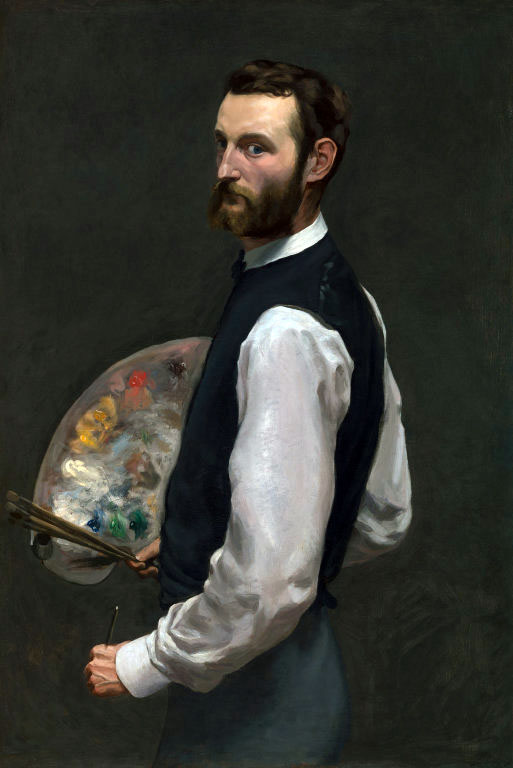
Self Portrait with Palette, 1865, oil on canvas.
Frédéric Bazille, 1841-1870, French. The Art Institute of Chicago on loan to the National Gallery, Washington DC in 2017
who, having produced exemplary work in seven years,
having participated with his friends and colleagues in the earliest evolution of Impressionism, without expectation of success
submitted his life to a fate which took that life young.

Portrait of Frédéric Bazille at the Farm of Saint-Siméon, 1864, oil on panel.
Claude Monet, 1840-1926, French. Musée Fabre, Montpellier, loaned to the National Gallery of Art, Washington DC in 2017
i love your blog its amazing . please think about visiting mine
I will follow and give a like! My Blog is about the GTA 5 Game. Check it out here http://www.puzzle3D.co
Every item of this is fascinating and reveals the painstaking process of your research. It is a beautiful introduction to an artist hitherto unknown by me. Thank you so much, Sarah, for the work you put into this moment in a life.
Thank you, Susannah, for your generous compliment! As always….