
Winterthur is the legacy of Henry Francis du Pont, 1880-1969, American
The hour of the snowdrops is all but done when the tiny Glory of the Snow (Chionodoxa forbesii) appears in the lee of woodland daffodils.


Tiny, of a vibrant purple blue and, also more rarely, pale blue,

they displace not only the snowdrops but also the spring crocuses, pushing them to the wall.

They take over where only last week the yellow Amur adonis was blooming

so that now the only yellow is a haze from the early forsythia

behind the bare bones of the stand of Sargent crabapples

and, louder, marching in single file to greet the dawn redwood.

Yellow also the Japanese dogwoods (Cornus mas and officinalis) which appear like wraiths at the beginning of its flowering cycle at this time of year.

No bushes are in bloom when the violet-blues begin to bloom except the Pieris japonica, pink and white.


and the early, fragrant viburnum, pink; and early Korean rhododendron also.


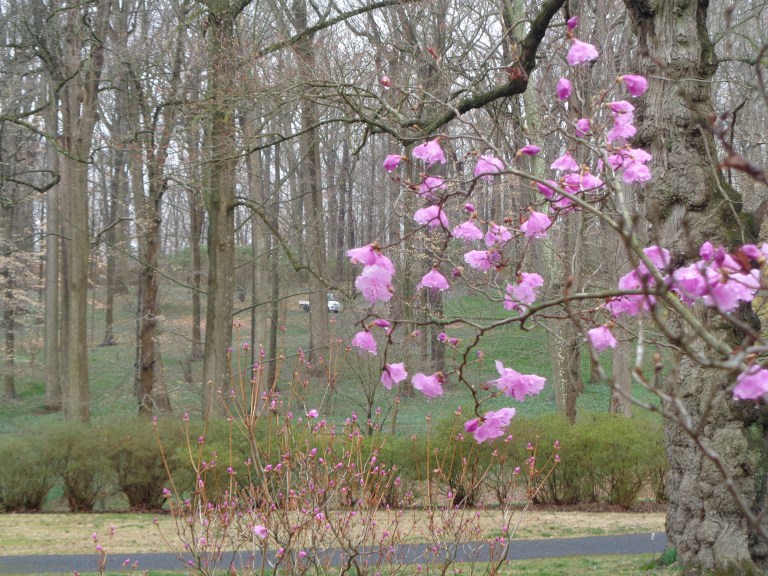
Korean rhododendron
If the bushes did not hold off,

this first squadrons of tiny Spring blues to bloom – squills and windflowers – would have no hope of basking in the sunlight and we would have less of our customary Spring solace.

Before they fade, the colours multiply while it is still April: native ephemerals, cherry trees, flowering quince, non-native magnolia, spirea, manchu cherry bushes, crabapple cultivars.

All year long, however, you remember the brown earth or green grass pricked in a thousand places by this gorgeous violet-blue.
Here for a moment only.

Yes, “Glory” – almost too grand a name for these humble pixie-like dancers. But the intensity of the colour has earned that tribute. You’ve caught that with your camera. And the perfection, having survived and bloomed on the heels of winter snows.
Thanks for this greeting-meeting with Spring and Glory of the Snow poem!
One learns the syllables of Nature in a language that can no way count as foreign, though not being one’s native vernacular; for – what matters is to sound (y)our greetings, to come to the encounter of (y)our projected when photographed views. So views are news!
So much poetry in your words, Ioana!
I agree with you: Nature’s language is not ours. Some of it is strange and difficult to understand. But not the colour of this flower because it is a blue and blue are relatively rare – ‘they’ say – in nature and because this blue is so vibrant!