
Syd Carpenter, American ceramicist born 1953
from a 2026 retrospective in metropolitan Philadelphia
Syd Carpenter was born in Pittsburgh, Pennsylvania. Moving to Philadelphia to study the arts, she transferred from painting to ceramics because of the mentorship of the master ceramicist Rudolf Staffel and the community of student potters.

From left to right on view at Woodmere, Philadelphia:
Green Seed, ceramic with acrylic paint, 1983, collection of the artist
Untitled (Lorraine’s Pot), terracotta and black copper oxide, 1985, gift to Woodmere
A House for Mr. Biswas, clay with underglazes, 1982, private collection
Late Season, clay with oxide washes, 1984, private collection
Syd Carpenter, American born 1953.
First works completed after receiving her MFA from the Tyler School of Art, Philadelphia in 1976 were pots.
There are many definitions of earth. The ones intended here are the ones the ceramicist presents in her work:
the clay of her material;
the earth of the vegetable garden her grandmother cultivated during the war and after; and of the garden of her mother; and her own garden in Philly;
the baked clay memorials of her love for her family;
the earth of farms of Black American farmers in the deep South of the US;
the practice of ‘hügelkultur’ to create sustainable gardens.
The ceramicist’s hand/mind, it would seem, have been engaged since the beginning of her work in a fulsome response to calls from the earth by way of the voices of her mother, Ernestine Carpenter, and grandmother, Indiana Hutson.
These voices have called on her to partner with the earth, to give it shape and form for a human society which, more and more, is oblivious to it, and does not remember that it is the ground of our being.
Among the definitions of ‘sacred’ is this:
the actuality of everything we did not and cannot create and whose presence, effects, interactions, continuance and disappearance surpass our understanding to a greater or lesser degree.
Earth is sacred.
The ceramicist has devoted her life to translating a substance which is sacred into objects which carry the meaning of that sacrality into our experience and lives:
history, memory, succour, interdependence and interconnection, love, beauty, hope for new growth come Spring, come Summer and Autumn. Death also.
This is the practice of courage, built slab by slab and coil by coil by her hand/mind until she has come recently to create at least one object larger and taller than herself.
I take this expanded size and mind to be evidence that she sees that the example and import of her work is far greater than she imagined at the start of her journey.
And this because of her collaboration with a substance which, in its sacrality, overflows human reach, expectations and imagination.


Rooted Mother Pin, 2021, clay, acrylic, and graphite
Syd Carpenter, American born 1953. Artist loan to Ursinus College’s Berman Museum, Collegeville, PA in 2026.
On the back wall two forms of the ceramicist’s Gingko Mother Pin, 2025.
**************************
Family


Love Letter, clay and acrylic, 1996
Syd Carpenter, American born 1953. Artist loan to Woodmere, Philadelphia in 2026
The artist resting on the head of her watchful husband, Steve Donegan.
Among the symbols Syd Carpenter uses for her mother are the clothespin, legumes, food storage jars, birds, soil, a tree, a house.
The shape of kidney bean, of course, is that both of a fulsome heart and of the human embryo.


Storage 1, clay, glass, steel wood, 2017, and details.
Syd Carpenter, American born 1953. Collection of the artist on loan to the Woodmere Museum of Art, Philadelphia 2018 Juried Show.


Mother Pin Arise, 2018, clay, graphite and watercolour
Syd Carpenter, American born 1953. Private loan to Woodmere, Philadelphia in 2026


Release, 2021, steel, clay and paper mache
Syd Carpenter, American born 1953. Artist loan to Ursinus College’s Berman Museum, Collegeville, PA in 2026


Rooted Mother Pin, 2021, clay, acrylic and graphite
Syd Carpenter, American born 1953. Artist loan to the Berman Museum, Ursinus College, Collegeville, PA in 2026


Mother Pin wit Floating Beans, 2021, clay, lentils and acrylic wash
Syd Carpenter, American born 1953. Artist loan to the Berman Museum, Ursinus College, Collegeville, PA in 2026


Mother Pin with House, 2021, clay, graphite, and acrylic
Syd Carpenter, American born 1953. Artist loan to Berman Museum, Ursinus College, Collegeville, PA in 2026


One of four Gingko Mother Pins, 2025, clay (other TBD).
Syd Carpenter, American born 1953. On exhibit at the Berman Museum, Ursinus College, Collegeville, PA
Frank


Frank as Sun King, 2005, mixed media
Syd Carpenter, American born 1953. Promised gift from the artist to Woodmere
The artist’s brother returned from his service in Operation Desert Storm in 1991, a quadriplegic. A ladies’ man, a sharp dresser, a dancer by his sister’s evidence, a much loved son and brother. He was left in a wheelchair.
He died of the consequence of these injuries.
The artist has dipped his army boots in bronze and placed them below this portrait of her brother as Sun King, an image which came to her when she was thinking about him.
Around his head rotate his attributes and those things he loved about his life.
The wheel of his wheelchair turned into the wheel of his life and of his radiant spirit.

Frank, 2007, clay and watercolour
Syd Carpenter, American born 1953. Artist loan to Woodmere, Philadelphia in 2026


Frank in Tow, 2008, graphite on clay
Syd Carpenter, American born 1953. Private loan to Woodmere, Philadelphia in 2026
His mother, perched on the wheels of her son’s wheelchair, watches over her son.


Frank’s Peace, 2002, clay over paint
Syd Carpenter, American born 1953. Artist loan to Woodmere, Philadelphia in 2026
Working the land
The history of Black Americans with North American land is as conflicted as any part of their history in North America.
It is also dense with contradiction because the farming of land was both the reason for their enslavement and the means by which they and their progeny survived.
From 1619 onwards, Africans were enslaved and brought to North America to work the land – cotton and tobacco primarily – in the project which made the first enormous wealth of the American republic.

Bowls in the ‘Farm Bowl Series’, clay, named for individual farmers mentioned in Richard Westmacott’s 1992 study; and farmers whom the artist met in her research in 2012
Various owners and lenders to Woodmere, Philadelphia in 2026
Syd Carpenter, American born 1953.


Green Farm Bowl, 2022, stoneware and acrylic
Syd Carpenter, American born 1953. Artist loan to Woodmere, Philadelphia in 2026

TBD, clay
Syd Carpenter, American born 1953.
Emancipation did not entitle Black Americans to ownership of land. Many continued to farm as sharecroppers while Jim Crow laws continued to deny such farmers the means to secure land in their own names.


Everelana Cannon, 2009, clay, acrylic and graphite.
Syd Carpenter, American born 1953. Woodmere, Philadelphia
The Great Migration in the first four decades of the 20th century was an escape to northern urban centers from southern states of an impoverished people needing work and a future.
The largest civil rights settlement (Pigford vs. Glickman, settled 1999) to date in the history of the country – $1 billion to fewer than 16,000 farmers – was paid as a result of a law suit filed for the denial of loans by the United States Department of Agriculture (USDA) to Black farmers between 1981 and 1996 because they were black.
Such loans are essential for the proper ordering of the farming year of small and individual farmers; and for the emancipation of shareholders into ownerships of their own farms.
This act of gratuitous racism was further compounded by the closure under Ronald Reagan (president 1981-1989) of USDA’s Office of Civil Rights. The complaints of Black Farmers were left in boxes and boxes in these locked offices.
Compensation by the Federal Government (‘Pigford 2’) to a further 70,000 Black American farmers was not dealt with until after 2010.
So grave and extensive has official abuse of Black farmers been that scrutiny of the practices of the USDA has continued even after these settlements; with dismaying results.


Ella Mae Edwards, 2009, ceramic, acrylic, graphite and wood
Syd Carpenter, American born 1953. James A Michener Art Museum, Doylestown, PA.
A map of the garden of Ella Mae Edwards.
Today there are fewer than 38,000 Black farmers of a total of 3.2 million.
It was in the context of this abysmal history, at the end of 400 years of abysmal history, that Syd Carpenter took up her research.
What she found speaks to the tenacity, discipline and the joy of those farming families who have succeeded in staying on their land; of their independence even in a time when systemic racism continues to deny them support offered to other populations of farmers.

Ellis and Anna Mae Thomas, 2009, clay, acrylic and graphite
Syd Carpenter, American born 1953. Skidmore College loan to Woodmere, Philadelphia in 2026


Percy Robinson, 2009, clay, watercolour, and graphite
Syd Carpenter, American born 1953. Rhode Island School of Design Museum loan to Woodmere, Philadelphia in 2026
1991: with her husband, Steve Donegan, Syd Carpenter bought a house in Philadelphia; and created a garden.
2012: Turning her mind to the gardens of her mother and grandmother, the artist began research on Black farming in the Deep South. Using an inventory of organic farms and research of 1992 by Richard Westmacott, (American born 1941), a former professor of environmental design at the University of Georgia, she visited farms in South Carolina, Georgia and the Gullah Islands.


Willie and Jelena Gray, 2009, clay and graphite
Syd Carpenter, American born 1953. Private loan to Woodmere, Philadelphia in 2026
Her farm works responded to interviews with farmers and the farms she visited. She has said how much she identified particularly with women farmers.
She named each of her pieces for the owner(s) of the farm she was representing. Most are covered with a dark, matte sheen to represent the skin of these owners.


Inez Faust, 2009, clay, watercolour and graphite
Syd Carpenter, American born 1953. Artist loan to Woodmere, Philadelphia in 2026
These works contain shapes which are both organic and sensuous; and man-made: sharp-edged and patterned and functional with marks in materials which men and women have imprinted on metal or wood.


Mary Lou Furcron, 2010, terracotta with acrylic paint, graphite and wood.
Syd Carpenter, American born 1963. Smithsonian American Art Museum, Washington, DC
A bird’s eye view of a homestead built by Mary Lou Furcron living in rural Georgia based on a map of such homesteads belonging to African Americans made in the 1980s.


Ramshackle Fence, 2008-2012, earthenware, graphite and acrylic
Syd Carpenter, American born 1953. Everson Museum of Art loan to Woodmere, Philadelphia in 2026
The artist has seen many such fences; made up of everyday objects which include her talisman for her own mother, a clothespin like those her mother used.


Albert and Elbert Howard, 2014, clay, steel and graphite
Syd Carpenter, American born 1953. Private loan to Woodmere, Philadelphia in 2026


Joseph and Helen Fields, 2014, clay, found objects and steel
Syd Carpenter, American born 1953. Joseph A. Michener Art Museum loan to Woodmere, Philadelphia in 2026
This evokes the farm of a married couple on Johns Island in South Carolina’s Gullah Geechee Cultural Heritage Corridor. The couple often invite would-be farmers to spend time with them and learn.


Mary Howard, 2014, ceramic and steel
Syd Carpenter, American born 1953. Artist loan to the Berman Museum, Ursinus College, Collegeville, PA in 2026


Home Places, 2025, mixed media and projection. Selections from series Places of Our Own
Syd Carpenter, American born 1953. Artist loan to the Berman Museum, Ursinus College, Collegeville, PA in 2026
A small farm house, with coat outside and gun to one side inside with film running filled with scenes of joyful and laborious farm life.
This is another way in which the artist memorializes one of the saving institutions and practices which have sustained a people for 427 years.
————————————
Shapes and energies of the earth


Below Ground, 1990, paint over clay
Syd Carpenter, American born 1953. Artist loan to the Woodmere in 2026


Check Your Sources, ceramic on wood, 1990
Syd Carpenter, American born 1953. Pennsylvania Academy of the Fine Arts loan to the Woodmere, Philadelphia in 2026
An evocation of the energy of a living form which cascades downwards.

Familiar Figure, 1991.
Syd Carpenter, American born 1953. Metropolitan Museum of Art, NY
A little over 4′ high, this large form in high relief was created by adding clay coils to a helix-like infrastructure.

Deep Roots, 1991.
Syd Carpenter, American born 1953. Metropolitan Museum of Art, NY
A little over 4′ high, this large form in high relief was created by adding clay coils to a helix-like infrastructure.

Nest, 2000, clay, acrylic and wood
Syd Carpenter, American born 1953. Artist loan to the Berman Museum, Ursinus College, Collegeville, PA in 2026

Various in the series ‘The Animated Leaf’;
loaned by the artist and two private collections to the Berman Museum, Ursinus College, Collegeville, PA in 2026.
Syd Carpenter, American born 1953.
The artist imagines leaves which have inhaled and inflated into three dimensions

Daughter of Old Soul, 2006, ceramic, part of ‘Animated Leaf’ series
Syd Carpenter, American born 1953. Private loan to Woodmere, Philadelphia in 2026


Two Birds Dancing, 2007, clay, slip, oxide
Syd Carpenter, American born 1953. Private loan to Woodmere, Philadelphia in 2026
Shapes and energies of the earth in human form


Of Like Mind, 1986-87, ceramic
Syd Carpenter, American born 1953. Private loan to the Woodmere, Philadelphia in 2026
A deep wall relief. The torsos invoke the body as the vessels of life and above a young person in dryadic form.

A Part of the Whole, 1989, ceramic mounted on plywood
Syd Carpenter, American born 1953. Woodmere, Philadelphia
Man in his environment, part built and part natural; all built parts are also derived from substances provided by the earth.

Then, Now, When, clay and slip, 1991
Syd Carpenter, American born 1953. Artist loan to the Woodmere, Philadelphia in 2026
Water and wind and their effect on organic forms: an amoeba-like form on the left and a woman on the right.

A Snake Without a Head is Just a Rope, 1994, glazed earthenware
Syd Carpenter, American born 1953. Philadelphia Art Museum
The reference is to a verbal and visual combat in a West African military society in which appliqued banners with metaphorical insults. One insult seeks to emasculate an opponent by characterizing him as a rope without a head and not a snake.
The creation unravels at its top into a nest of a harbour.


Child 5, clay and terra sigillata, 1990
Syd Carpenter, American born 1953. Private loan to Woodmere, Philadelphia in 2026

Child 4, clay and terra sigillata, 1990
Syd Carpenter, American born 1953. Artist loan to Woodmere, Philadelphia in 2026


Four Seasons of Interest, 2002, clay, acrylic and graphite
Syd Carpenter, American born 1953. Artist loan to the Berman Museum, Ursinus College, Collegeville, PA in 2026

Breathe, 2004, watercolour on clay
Syd Carpenter, American born 1953. Woodmere, Philadelphia
Hügelkultur
Hügel means mound or slope in German.
Hügelkultur is an old practice, German and Eastern European, of using logs and other organic material to create pyramids wood.
‘La Cresta’ is the name of Woodmere’s hügel garden.
A second garden has been built at Ursinus College, Collegeville, PA.

The artist and her husband at the newly planted hügel garden at Ursinus College in 2024 from whose website this photo
At Woodmere, the base of the garden and a pathway around and through its two parts are cross sections of forty trees which Woodmere had had to cut down. Trunks, boughs, organic matter have been heaped on these to create the mounds.
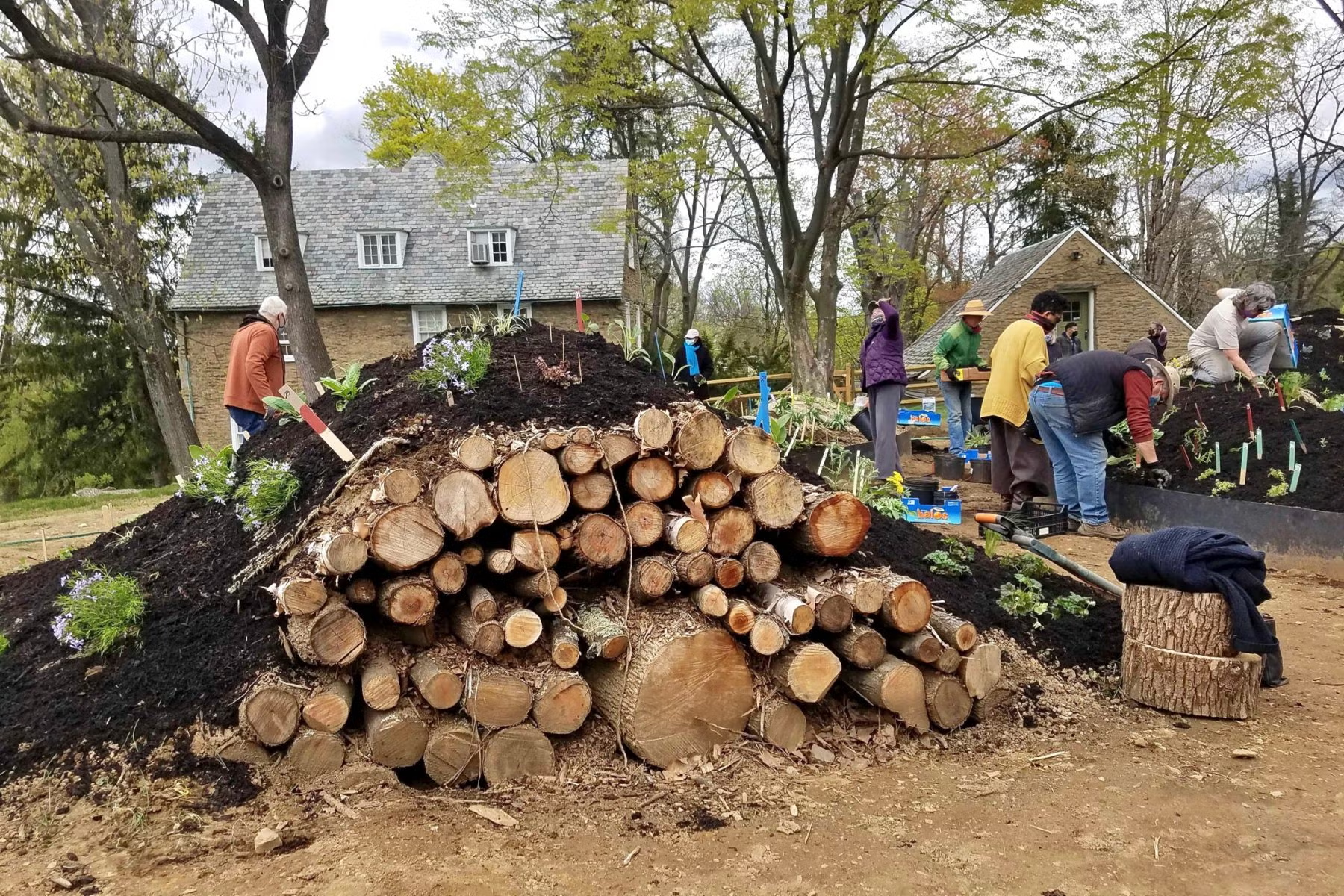
A cross-section of La Cresta before planting by the artist, her husband and volunteers. April 2021. Photo by Peter Crimmins/WHYY
The mound interior decomposes over time to feed the roots. The slope of the mounds keeps water from flooding those roots. The composting process generates some natural heat, extending the growing season in late Autumn.

Syd Carpenter at a newly planted La Cresta. May 2021. Photo from The Chestnut Hill Local.
As the wood slowly decomposes, it stores moisture and releases nutrients. Plants are grown on top of the mounds.
La Cresta in September 2022


After several years, the mounds will break down and flatten; and a new garden can be remade on rich, compacted earth.
What a rich and informative post!
I wasn’t familiar with Syd Carpetre and her ceramic and sculpture works.
I really liked the “Mother Pin” brooches
… and I was moved by the tragedy of her brother, who was paralyzed in an accident during the Gulf War.
Thank you, Luisa, for your comment.
Syd Carpenter’s work is faithful and heartening and keeps us going in these difficult times.