
Roberto Lugo, American born 1981
Roberto Lugo is a ceramicist.


Self-portrait as Street, 2019, earthenware, concrete, resin, found objects, base, chains, gun parts.
Robert Lugo, American born 1981. On exhibit at the Philadelphia Art Museum in 2021
He was born to Puerto Rican immigrants to mainland United States. They settled in the Kensington area of Philadelphia during a time when not only Kensington but a vast swath of Philadelphia had fallen into decay and ruin.

Alberto Ayala, acrylic on wood, ?date
In front, a potpourri boat, painted porcelain, ?date
Roberto Lugo, American born 1981
The artist’s grandfather.
Kensington is called by the artist and many others, the ‘ghetto’. It is also sometimes called ‘the Badlands’ by Philadelphians. It has long had the reputation of including the largest drug market on the east coast of the US.
The decline of this and other areas of the city followed a sharp decline in manufacturing jobs beginning after WW2. These jobs moved to Asia and to Central America. Significant numbers of people were left in poverty and became prey to waves of drug dealing and drug taking which began in the 1970s and continues to some degree to this day. Whole streets were abandoned. Houses fell down.
Roberto Lugo’s family was poor.
His mother worked three part-time jobs. His father cycled daily 20 miles (32 kilometers) round trip across the Delaware River to New Jersey for work. He grew up in an area in which public schooling was so poor that students became neither literate nor numerate.


Do you know how hard it is to get a black man through high school, 2019; earthenware and acrylic paint.
Robert Lugo, American born 1981. Philadelphia Art Museum
The image is of Michael Brown, an unarmed African American teenager, who was fatally shot by a white police officer in Ferguson, MI in 2014. Brown is wearing his high school graduation cap.
Lugo sees his fate as an artist, a man, who has survived, as miraculous because Michael Brown’s fate, he believes, could have been his.
Lugo, his brother, his cousins and friends grew up with violence, anomie, and existential hopelessness.

A century of Incarceration, 2016, porcelain
Robert Lugo, American born 1981. Photo courtesy of the artist from the web
Their artistic expressions were (are) hip-hop and graffiti.
Some of their companions died on the streets. Others are in prison.
Lugo’s brother served time in prison on what appear to be specious grounds.


Street shrine 2, earthenware.
Robert Lugo, American born 1981. On display at the Clay Studio in 2023
Street shrines, almost always ephemeral, are a Philadelphia institution to mark the site of a killing, often of a young person or of a child caught in gun cross-fire.
Escaping Philadelphia, Roberto Lugo went to Florida in his mid-20s. There he had his first art course in ceramics at a Community College.
He bought a wheel and a kiln and began making and selling pots for $15. That work was good enough to win him a scholarship to study at the Kansas City Art Institute where he earned a Bachelor of Fine Arts; later a Masters of Fine Art at Pennsylvania State University.

The artist’s statement in graffiti style. Unknown date and medium
Pottery saved my life, he says. I did not think I had any worth, he says. He begins to cry. But then, he says, I see that my work has some worth.
He has studied the Western and Asian ceramic traditions. He has taken their forms – Greek amphora, lidded urn, Sèvres porcelain vase, English teapot Chinese bowl – and he has adapted them: decorating them with representations of people, historical references and items which have cultural or historical meaning to his people (our people).
Their painted surfaces also feature classic decorative patterns and motifs. These are combined with the marks of urban graffiti.
The portraits he paints on his work are those of people who are not seen in museums and galleries and are not associated with decorative ceramic ware.
His subject is representation. That of his people (our people) and of himself.


Maribel and Child, glazed stoneware, acrylic, enamel, birch, pine and lacquer; 2023
Roberto Lugo, American born 1981. On exhibit at the Clay Center, Philadelphia in 2026
The artist has taken inspiration from the brilliant white and cerulean tin-glazed work of Luca della Robia, Italian, 1400-1482.
He has kept himself close to the community of his birth. He has created a ‘brand’ called ‘Village Potter’. He makes objects for people to use: book ends, cups, bowls, mugs, butter dishes in the shape of our suburban-urban trains. Also clothing.


Putti book ends, glazed stoneware, luster; date?
Roberto Lugo, American born 1981 on view at the Clay Studio, Philadelphia in 2026

Juicy Drank Teapot, glazed stoneware, luster; ?date
Roberto Lugo, American born 1981
Juicy is a name for Biggy Smalls, 1972-1997, American, a rapper and songwriter of large influence.
The artist’s parcours, his skill, his aesthetic sense, the combination of modesty and self-knowing, daring and creative confidence are astonishing.
His ceramic work – particularly the porcelain whose difficulties he has not shunned – is very fine.

All about the Benjamins Century Vase, 2016, porcelain, china paint, gold luster
Roberto Lugo, American born 1981. Photo by KeneK Photography, courtesy of Wexler Gallery, Philadelphia
A reference to Benjamin Franklin, 1706-1790, a leading citizen of Philadelphia, a polymath, and a signer of the Declaration of Independence.
Today Roberto Lugo lives and works in Philadelphia again.
When he turns his wheel, he thinks, he says, of the wheels of his father’s bicycle on its daily grind to earn enough to sustain his family.


Pot to Piss In, ceramic; ?date
Roberto Lugo, American born 1981
The artist says that today he has his own pot to piss in; and he mae it himself.
He continues his ceramic work; he teaches ceramics; he draws almost ceaseless attention to social issues which need political attention; and he creates spoken word poetry.

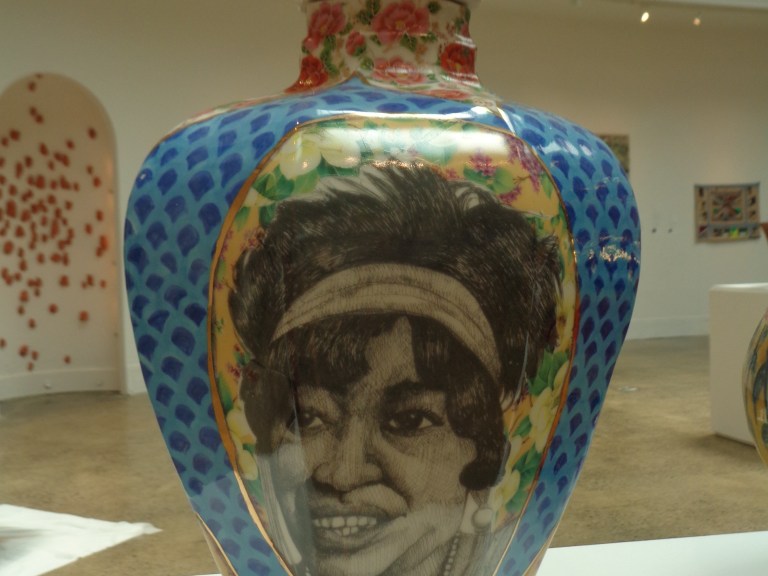
Billy Holliday and Matthew Henson vase, terracotta, china pain, luster; ?date
Roberto Lugo, American born 1981. ?Location
Billie Holiday, 1915-1959: jazz and swing singer and songwriter. On the reverse is Matthew Henson, 1866-1955: an experienced arctic explorer who was the first of his party to reach the North Pole.
That he has been able to use and adapt the Western and Asian traditions to create so productive a life is not the least most marvellous aspect of this story.

Roberto Lugo in an undated photo taken from the web
————————–

Roberto Lugo, Century Vase III: American Refugees”, 2015, porcelain, glaze, china paint (photo courtesy of Wexler Gallery)
The handles are small busts of George Washington and Theodore Roosevelt.
Featured are barbed wire, flags, a portrait of Frederick Douglass. The word ‘CAUTION’ is scrawled across the Washington portrait.

A Century of War, 2016, porcelain.
Roberto Lugo, American born 1981. Photo courtesy of the artist from the web
Lugo has created several ‘Century vases’. They take their inspiration from 19th century vases designed by Karl L. H. Müller for the 1876 Centennial Exhibition held in Philadelphia.
Miller’s images included scenes of the Revolutionary War, William Penn’s 1682 compromise that resulted in the seizure of Indigenous Lenape land. The heads of North American bison form the handles, and images of telegraph poles, sewing machines, and other American innovations frame low relief portraits of the country’s first president, George Washington.
Roberto Lugo’s Century Vases depict the artistic and cultural achievements of Black citizens: Brooklyn Dodgers player Jackie Robinson, 1919-1972, who broke the color barrier in baseball; and The Notorious B.I.G., 1972-1997, an innovator of rap; and others.




Urns, 2017, porcelain, china paint, luster.
Roberto Lugo, American born 1981. Loaned by the artist and his gallery to the Woodmere, Philadelphia in 2018


Frederick Douglass and Ann Murray Douglass Vase, ceramic glaze and enamel paint, 2021
Roberto Lugo, American born 1981. Smithsonian Museum of American Art


Juicy, 2021, stoneware with enamel paint, glaze and luster.
Roberto Lugo, American born 1981. Smithsonian Museum of American Art
In the manner of 19th century vases commemorating George Washington, Lugo remembers the big innovators of Hip-Hop: Tupac Shakur and The Notorious B.I.G.

What Had Happened Was: Jackie Robinson, from the ‘Orange and Black Series,’ 2024; glazed terracotta
Roberto Lugo, American born 1981. Photo from the web courtesy of the artist and R & Company, New York

“The Chase (Tag)” from the ‘Wedgwood’ series, stoneware and enamel, “The Chase (Cops & Robbers)” (2024), stoneware and enamel
Roberto Lugo, American born 1981. Photos by Logan Jackson from the web
 The Day My Sister’s Chain was Stolen, glazed terracotta, ?date
Roberto Lugo, American born 1981. On display at the Clay Studio, Philadelphia in 2026

Food Stamp Ware: Delft Pottery, 2025: amphora made of glazed stoneware and luster Roberto Lugo, American born 1981. Photo from the web


Roundel with Bust of Poet, 2026, glazed stoneware, acrylic, enamel, birch, pine, lacquer
Roberto Lugo, American born 1981. On exhibit at the Clay Studio, Philadelphia in 2026
The artist has taken inspiration from the brilliant white and cerulean tin-glazed work of Luca della Robia, Italian, 1400-1482.
———————————-
‘Ceramic-inspired’ works
The artist has begun working with a private atelier in New Jersey to explore new materials and large-scale fabrication processes, expanding his practice into monumental public artworks.


Capicú de Cariño (I Heard It Both Ways), 2026, hand-painted milled foam, acrylic paint, twenty-foot-high in the shape of an urn and recalling traditional ceramics. It is painted with portraits of Puerto Rican figures.
Roberto Lugo, American born 1981. Commissioned by Madison Square Park Conservancy for its park, NY. Photo by Timothy Schenck
Figures are of the reggaeton superstar Bad Bunny, the US supreme court justice Sonia Sotomayor, the actor Lin-Manuel Miranda, the baseball legend Roberto Clemente and include the artist’s parents: Gilberto and Maribel Lugo.
215 is the oldest of Philly’s telephone area codes.
Domino tables designed with his father; and painted tires filled with Puerto Rican plants accompanied this creation.


DNA Study Revisited, 2022, urethane resin life cast, foam, wire, acrylic paint
Roberto Lugo, American born 1981. Smithsonian American Art Museum, Washington, DC
The artist painted a resin cast of his own body.
Each of the 4 patterns represents his ancestors: from head to toe: Taino (Indigenous peoples of the Caribbean), Spanish, African and Portuguese.
The exhibition in which this was included at the Smithsonian, Washington, DC was condemned by Donald Trump in an executive order in early 2025, among other exhibitions. He prohibited future federal funding of exhibits that, in his view, “degrade shared American values” and “divide Americans based on race.”
My art is not about divisiveness but trying to find my place in the world and connect with others and represent my culture, ancestry and community within the context of American history, was the artist’s response.
I’m from the ghetto, he has said. I never forget how I could have easily ended up on a different path.
What an amazing artist! Thank you for letting me discover Roberto Lugo through this post.
The photos of his ceramics are stunning!
Admiring these photos and reading about his life really shows how powerful art can be