
Reverie from an Old French word from at least the middle of the 14th century: resverie meaning wild conduct, frolic, revelry, rejoicing, wantonness, raving, delirium. (Modern French rêver: to dream).


Young Man in Reverie, 1876, oil on canvas.
John Singer Sargent, 1856-1925, American active Europe. Private collection loan to the Metropolitan Museum of Art, NY in 2025
Thought to have been painted on a summer visit to Naples or Capri.
It is a state, triggered by an external stimulus in which we spontaneously enter an internal world whose emotional atmosphere is heightened and pleasant. Even very pleasant.
Reveries also split time. In reverie we are in an extended present while we are aware that time is, nevertheless, passing as it inevitably does.

Study for The Dreamer (Caroline Kilby Smith), 1894, umber and white chalk on beige primed canvas.
Cecilia Beaux, 1855-1942, American. Pennsylvania Academy of the Fine Arts, Philadelphia
The only evolutionary suggestion I have seen for the function of reverie is to force women to concentrate, frequently and pleasurably but without choosing and without distraction, on the needs of babies who are simply not able to survive without concentrated adult attention.


Washerwoman and Child, 1886, oil on canvas.
Auguste Renoir, 1841-1919, French. Barnes Foundation, Philadelphia
An unusual palette for this artist.
There is reverie brought on by the symbols of death of which the most famous, in the Western tradition (memento mori), are the skull and the sputtering candle.


The Repentant Magdalene, oil on canvas, 1635-40.
Georges de la Tour, 1593-1652, French. National Gallery of Art, Washington, DC
This kind of reverie cannot be thought of as a negative experience because it belongs in the spiritual tradition and the effect on the person is probably one of acceptance of a fate (death) which cannot be avoided.

The Penitent Magdalen, 1640, oil on canvas
Georges de la Tour, 1593-1652, French. Metropolitan Museum of Art
AI did not respond to the question: do animals have reveries? It said only that animals experience dreams because they have REM eye activity while sleeping.
So, the answer is no and what this sheep is doing in his looking cannot be known by us, humans.


Have You Any Wool, 2007, acrylic on panel.
Karl J. Kuerner Jr., American born 1957. Private loan to the Brandywine Museum in 2024, Chadds Ford, PA
Nor can you be engaged, it seems, in physical activity while you are in reverie because the brain halts all physical activity in the body.


Repose, 1911, oil on canvas.
John Singer Sargent, 1856-1925, American. National Gallery of Art, Washington, DC
It is interesting that AI thinks that we can put ourselves willfully into a state of reverie.
The trigger for a reverie seems to be an interaction between the conscious and unconscious mind; and so this answer from AI may be an example of its famous (notorious) emotionally empathetic answers. It knows we like reveries and we want to generate them whenever we want to. (But we cannot.)
It seems, also, that most people cannot recall the adventures of a reverie. Unless they are poets.
We do, however, recall that we have just been in reverie because we are in our fully conscious mind when we return to our ‘real’ lives: there is a jolt of perception and an instant of regret.
We may even look around sheepishly to see if our ‘absence’ was noted.


Interior of a Tavern, oil on canvas, 1886.
Peter Severin Kroyer, 1851-1909, Danish. Philadelphia Art Museum
There is news that there is a condition called ‘intrusive reverie’ in which an individual can spend such a lot of time in a state of reverie that his/her life is seriously undermined. Additionally, in this state, subjects talk to themselves and can even move their hands and fingers.
This is a different order of human experience which is thought to be related to psychological disturbance of one kind or another.
That the word ‘reverie’ is used for them may harken back to the original definition of the word: a delirium.


A Corner of the Moulins de la Galette, 1892, oil on cardboard.
Henri de Toulouse-Lautrec, 1864-1901, French. National Gallery of Art, Washington, DC
The reverie, as we know it, is the fabled land of poets. And of children.

Stéphane Mallarmé (1842-1898), 1876, oil on canvas.
Édouard Manet, 1832-1883, French . Musee d’Orsay loan to the Metropolitan Museum of Art, NY in 2024

William Butler Yeats (1865-1939), 1908, charcoal.
John Singer Sargent, 1856-1925, American.
Commissioned as the frontispiece of the first volume of the poet’s ‘Collected Poems’ published in 1908. Private collection on loan to the Morgan Library, NY in 2019.

Langston Hughes, 1925, pastel on illustration board.
Winold Reiss, 1886-1953, American born Germany. Smithsonian National Portrait Gallery loan to the Metropolitan Museum, NY in 2024
And which the rest of us, ordinary mortals, inhabit periodically, fleetingly, away from the logic of reason, the constraints of our societies and the pressure of everyday demands.
There we can live the multiple other lives of our vast human imaginations far from the intrusion of everyone.
——————————-


Portrait of a Young Girl, oil on canvas, 1881-82.
John Singer Sargent, 1856-1925, American. Baltimore Art Museum

Portrait of a Young Girl, 1899, oil on canvas.
Mary Cassatt, 1844-1926, American. Metropolitan Museum of Art, NY

The Charwoman, 1904, oil on canvas
Romaine Brooks 1874-1970, American active France, Smithsonian American Art Museum


Le Repos (Repose); oil paint on canvas; c. 1871.
Édouard Manet, 1832-1883, French. Rhode Island School of Design Museum loan to the Metropolitan Museum of Art.
The subject was Berthe Morisot, an artist; a friend of both Degas and Manet; and the wife of Manet’s brother, Eugene.


Polly, 1928, oil on canvas.
Alice Kent Stoddard, 1883-1976, American. Pennsylvania Academy of the Fine Arts, Philadelphia

The Sailor (Einar Rutter), 1918, oil on canvas
Helena Schjerfbeck, 1862-1946, Finnish. Private loan to the Metropolitan Museum of Art, NY in 2025


When She Was a Little Girl, 1918, oil on canvas.
Lilian Westcott Hale, 1880-1963, American. Pennsylvania Academy of the Fine Arts, Philadelphia
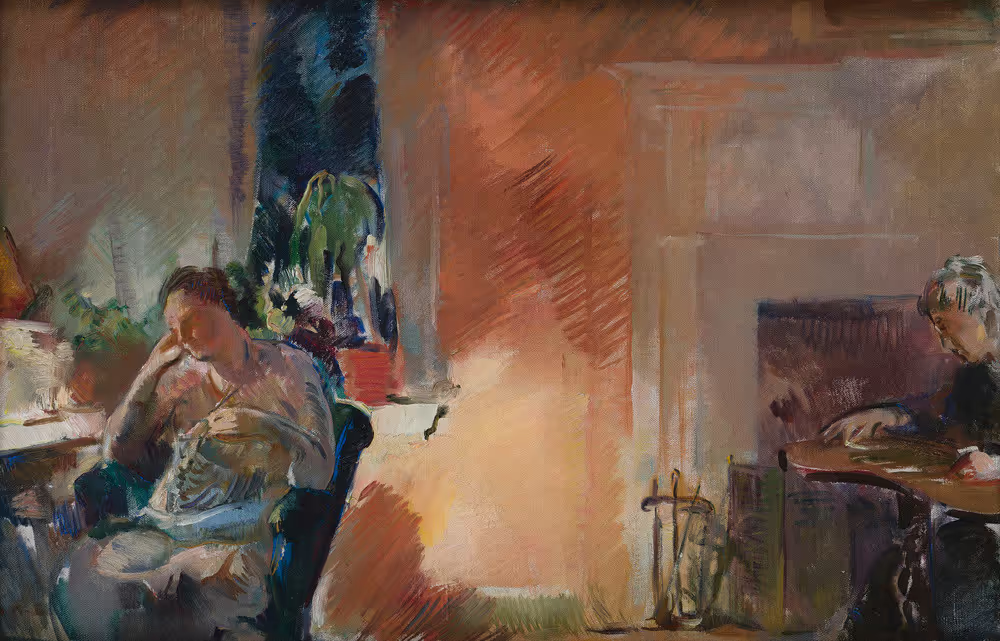
Contemplation, 1935, oil on canvas.
Alice Kent Stoddard, 1884-1976, Woodmere, Philadelphia


Fidelma, tempera and oil on Masonite, 1937
Paul Cadmus, 1904-1999, American. Delaware Art Museum, Wilmington, Delaware.
Sister of the artist and the wife of Lincoln Kierstein, the founder of two companies of ballet in New York

Mahlinda, 1939, oil on burlap.
William H. Johnson, 1901-1970, American.
Smithsonian Museum of American Art on loan to the Wallach Gallery, Columbia University in 2018/19


The Study of a Student, c. 1940, oil on canvas.
Laura Wheeler Waring, 1887-1948, American. Pennsylvania Academy of Fine Art, Philadelphia

Michael Greenwood at Pett Rectory, 1950, oil on canvas.
Sylvia Sleigh, American born Wales, 1960-2010. Baltimore Museum of Art


Woman with Red, 1962, oil on canvas
Elizabeth Osborne, American born 1936. Pennsylvania Academy of the Fine Arts, Philadelphia


The Rest, 1966; nylon, cotton, satin, kapok, human hair, plastic, paint, wood, chair, floor, lamp.
Jann Haworth, American born 1942. Loaned to the Philadelphia Art Museum in 2016


Afternoon (Peggy Karp on a Striped Sofa), 1968, oil on canvas
Mitzi Melnicoff, 1922-1972, American. Woodmere, Philadelphia


Double Libby II, 1971-72, on acrylic on canvas.
Shirley Gorelick, 1924-2000, American. Baltimore Museum of Art


Chillin’, clay, wall paint, acrylic paint.
Susan Strassberg (no other information) on exhibit at the Clay Studio, Philadelphia in 2015


Krasner, 2002, woodcut
Dan Miller, American born 1928. Pennsylvania Academy of the Fine Arts, Philadelphia


Untitled, 2022, acrylic on canvas.
Henry Taylor, American born 1958. Loaned by the artist and his gallery to the Whitney, NY in 2023


Haze, 2024, oil on linen.
Danielle Mckinney, American born 1981. Metropolitan Museum of Art, NY
Dear Sarah, what a truly remarkable tribute to the art of reverie!
Your thoughtful reflections have provided such a rich context for these paintings. Thank you for sharing this post; it was fascinating and wonderfully informative.
Thank you, Luisa, as always for your tribute!
I like best of all that reverie opens up the imagination to the other ways of being human which we know with our rational minds and usually judge and foreclose for ourselves!
Thanks a lot also for this wonderful reply, my dear Sarah!