Good Friday 2026 (Western)
In memoriam Susannah Harris Wilson, born 1939, San Francisco, US – died 2026, Oxford, UK.
Dearest friend of many decades. She lived and worked in the US, the UK and in her beloved Lahore, Pakistan. She lived into her largest imagination and loved many of us.
Susannah died this week.
A believing and active Christian, she came to Anglo-Catholicism and, in the last few years, to a belief in the solicitude and mediation of angels. Rafael, the archangel who heals, accompanied her in her terminal, catastrophic illness.
This representation of the archangel Michael Susannah knew well for every day she left and returned to Philly by train in the more than 20 years she lived here.


The Angel of Resurrection, (the archangel Michael), 1949-1952, bronze memorial for the WW II war dead of the Pennsylvania Railroad
Walter Hancock, 1901-1988, American. Amtrak’s William Gray III (interstate rail) Station (30th Street Station) in Philadelphia.
Some of the images below of the sorrow of Good Friday which ripples in huge waves outwards from unjust killings and incomprehensible, often untimely deaths, were long an aid to her meditation on Good Friday.
Beloved, rest in peace!
———————————-
The deposition in Christianity is the taking down of Jesus from the cross of his crucifixion.
The ‘Pieta’ is the image of his mother’s sorrow. The image may contain others, including angels.
The ‘Angel Pieta’ is the dead Jesus supported by angels.


The front panel of one of 4 panels of the Orsini Polyptych, tempera and gold leaf on panel, c. 1335-40.
Simone Martini, Italian, 1315-1344.
Loaned by the Musee de Louvre, Paris; Royal Museum of Fine Arts, Antwerp-Flemish Community; Staatliche Museen zu Berlin to the Metropolitan Museum of Art, NY in 2023

Sarcophagus fragment (Death of Meleager), Roman, mid-2nd century, marble with 15th century Italian restoration. The Metropolitan Museum of Art, NY


Composition study for the Entombment (The Baglioni Altarpiece), c. 1507; pen and brown ink over black chalk, and preliminary stylus under-drawing on paper.
Raphael (Raffaello Sanzio or Santi), Italian, 1483–1520. British Museum loan to the Metropolitan Museum, NY in 2026.
The artist had intended something quite different for this commission. Then, upon study of marble reliefs from Roman sarcophagi like the one above of the death of Meleager, Raphael reworked his intention for this work to make it conform to Roman practice close to the time of Jesus’ death.


Descent from the Cross, marble with traces of gilding, c. 1555
Follower of Jean Goujon, c. 1510-c. 1565, French; after an engraving of by the printmaker, Marcantonio Raimondi, c.1480-before 1584, Bologna, Italy. Metropolitan Museum of Art, NY


Sepulchrum Christi (The Dead Christ with Joseph of Arimathea and Nicodemus, c. 1495-98, oil and tempera grassa on wood, transferred to canvas and mounted on wood.
Perugino (Pietro di Cristofero Vannucci), 1446/50-1523, Italian. Clark Art Institute, Williamstown, MA. On view at the Raphael exhibition in 2026 at the Metropolitan Museum of Art, NY

Study of a Pieta (Entombment), red chalk over traces of black chalk.
Michelangelo, born the Florentine Republic 1475, died Rome 1564. Loaned by the Albertina, Vienna to the Metropolitan Museum of Art, NY in 2017/18


Descent from the Cross, 1917, oil on canvas.
Max Beckmann, 1884-1950. German. MOMA, NY


Deposition, 1961, oil on canvas
Bob Thompson, 1937-1966, American. Philadelphia Art Museum


Deposition, 1973, silkscreen on polished stainless steel
Michelangelo Pistoletto, Italian born 1933. Cittadelarte – Fondazione Pistoletto on loan to the Philadelphia Art Museum in 2010/11


The Flesh Eaters, 1996, oil on canvas
Edward E. Boccia, 1921-2012, American. Collection of the Art Students League of New York loan to the Calandra Italian-American Institute, NY in 2024/25
The two panels on either side of the central panel tell a tale of violence, cruelty, cannibalism, and sophisticated indifference.
During the period of this painting, ten years after the death of his son, the artist was in illness which included the necessity of a kidney transplant.
The artist is holding up the dead Christ. A horned devil in the right-hand panel also has the artist’s face.
The artist represents Christ as a symbol of universal suffering.
The entire tableau, full of venality, murder, and evil reminds that participation in the Eucharist – acceptance of the redemption offered by Christ – is a symbolic flesh-eating.


Dead Christ Supported by Angels, c. 1710, oil on canvas.
Francesco Trevisani, 1656-1746, Italian. Metropolitan Museum of Art, NY


The Dead Christ with Angels, 1864, oil on canvas
Edouard Manet, 1832-1883, French. Metropolitan Museum of Art, NY


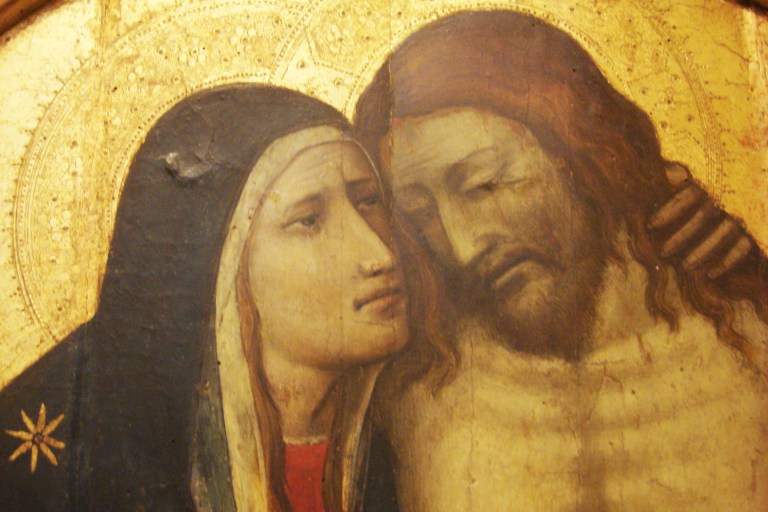
Pieta, 1377, tempera and tooled gold on panel.
Nicolo di Pietro Gerini, first documented 1367, died 1415; Italian, active Florence. Philadelphia Art Museum.

Pietà in the Desert, 1942, fresco on metal frame.
Manuel Rodríguez Lozano. Loaned by Museo del Palacio de Bellas Artes, Mexico City to the Philadelphia Art Museum in 2016.
Rodríguez Lozano had been falsely accused of stealing three prints from the School of Fine Arts. Mexico City, when he was director. He was imprisoned in the Lecumberri Prison in that city. The prints were later found.
Rodríguez Lozano painted this on the prison walls from which it was later removed.

Pieta 1, 1958, oil on canvas.
Sam Feinstein, 1915-2003, American. Loaned to Woodmere, Philadelphia in 2021 by the Sam Feistein Trust


Madre del Nene, 1990, oil on linen
Bo Bartlett, American born 1955.
The artist’s son died as a small child. His mother is depicted in agony and also holding herself up. The tableau is set in south-west Philadelphia as the Interstate 95 was being built.


Pieta, 2008, wax, epoxy, metal, wood.
Berlinde de Bruyckere, Belgian born 1964. On loan in 2018 to the Metropolitan Museum, NY by a private collection.


Sacrifice, 2014, bronze and found wooden object.
Nick Cave, American born 1959. Private collection loan to the Solomon R. Guggenheim Museum, NY in 2022

A woman embraces the body of her niece killed in Israeli strikes. October 17, 2023, Khan Younis, Gaza
Mohammed Salem/Reuters posted to the net
Love is the burning point of life, and since all life is sorrowful, so is love. The stronger the love, the more the pain.
Love itself is pain, you might say – the pain of being truly alive.
Joseph Campbell, 1904-1987, American in The Power of Myth, 1988.
I’m sorry for the grief you feel for your friend’s loss.
Please feel my presence.
PS: As always, I found the artwork you shared truly wonderful.
What a generous thing to say: ‘Please feel my presence’! And I do, thank you for the sympathy.
I don’t know if you know of Van Eyck’s ‘Descent from the Cross’. It can be seen online. It is at the Prado; and is said to be the master source for some of the images here.
Easter is soon. Happy Easter, Luisa!
Thank you again, dear Sarah… and Happy Easter to you too 💞🕊️💞
So sorry to hear of your friend, Sarah
Thank you, Carl. Sarah