
Mt. Cuba, Hockenville, DE, is a reserve of native plants. Legacy of the Lammot du Pont Copelands
The former Copeland family home is less than 100 years old.
Uninviting as architecture. Most rooms are not open to the public.

One room is very pleasing: the sun room

with its magnificent orchid


Climbing monkshood (Aconitum uncinatum) grows in pots outside the sun room on the terrace


Here is a partial view of the piedmont in early October –
with its pots of hairawn muhly grass (Muhlenbergia capillaris) and a row of Virginia sweetspire with dark red leaves

Between this building and the woodlands are a formal garden and an experimental garden.
Into the woodlands
where the flowering of natives is almost done by early September.

Swamp rose mallow (Hibiscus moscheutos)


On the left a dazzling path into the meadow garden which you don’t take.

Instead you descend to the coven of witches brooms of white pine with their branches pointing every witch way

and large boughs lying almost parallel to the ground
pointing to the sun of the meadow garden


Down the path further to the lakes: two of them, treated with black organic dye against algae.
Frogs croaking.

A small lake and a far bigger one


Flag stones lead you over a trickle between the two lakes to the far side of the larger lake.


Black turtles sun themselves in the large lake.

Around both lakes and along the path are cardinal flowers (Lobelia cardinalis)

and modest woodland sunflowers


and a variety of asters


Phlox (Phlox paniculata) grows along the path, here with swallowtail butterflies


Black-eyed susans (Rudbeckia hirta) are also here

and Indian Pink (as in pinking shears: Spigelia marilandica)


Near the water, woodland spider lily (Hymenocallis occidentalis) which we so rarely see.


The path reaches a gazebo.

Lotus plants grow in the lake in front of the gazebo.


On the opposite side of the lake are waterlilies.

Great blue lobelia (Lobelia siphilitica)


The path continues over a bridge.
Below, the lake streams into a third and last small pool of water on land which slopes down hill.

Below the bridge and close to the edge of the large lake,
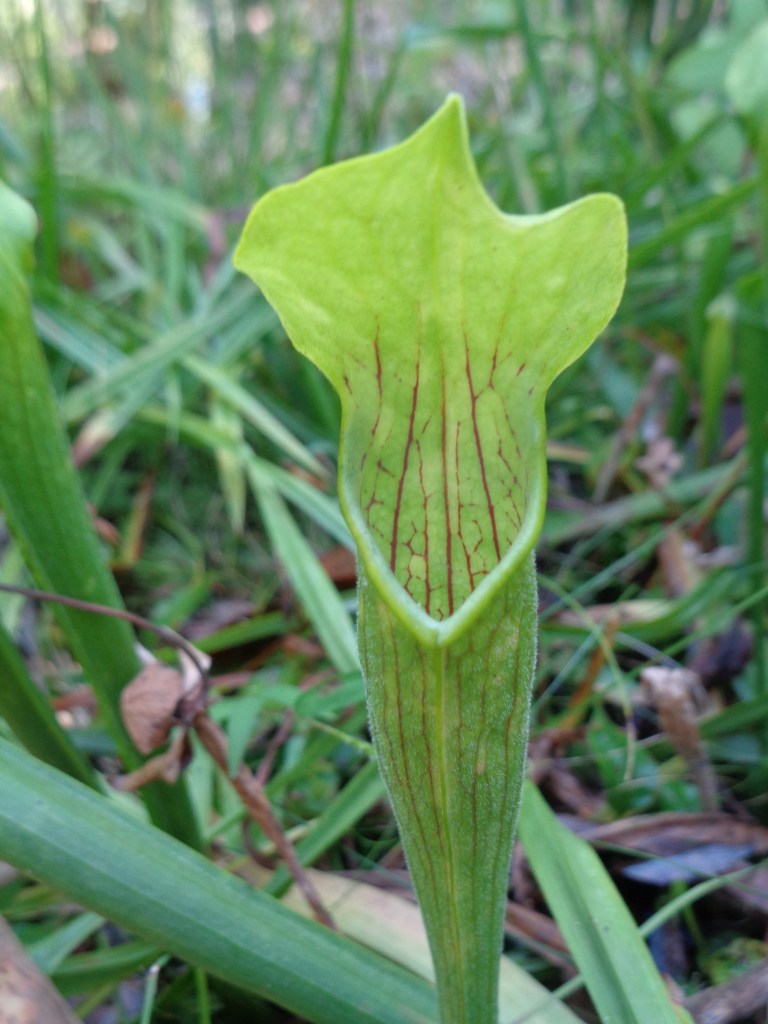
carnivorous pitcher plants (Sarracenia) are still enticing flies and other insects into their pitcher tubes made of their modified leaves.


Southern camas (Zigadenus glaberrimus) grows in the water.

this photo from the website of Mt. Cuba Center

Closed bottle gentian (Gentiana clausa).
Thought to be moving to extinction in states north of Pennsylvania.
But this is not, perhaps, a surprise especially since a decline in the number of bees has been noted.
To get to the nectar, bumble bees have to break open the plant from the top. Other bees try to hurtle their way in from the base of the plant.


Pickerelweed (Pontedaria cordaria) grows in the water among waterlilies and lotus plants.


Sitting in the gazebo, you can see the meadow garden in the distance, sloping a little upwards.
A red oak tree is in the middle of the frame.

I visit the meadow often.
It comes into its own from late August onwards.

The grasses 2 weeks ago were a mint green as cool as the promise of a cooling September.


Now the grasses are a cream-white tinged with the yellow of goldenrod and black-eyes susans.
Late varieties of goldenrod are kings of the open fields now.


Until late November, the grasses cycle through glorious shades.
They become taller than most people.
In late November, the garden closes. Then the grasses die, out of our sight.
In full view of the hawks, though, always wheeling above looking for voles in the meadow garden.
<3
What a gorgeous floral trail, Sarah. Thank you for all those lovely introductions, the familiar and quite unknown. That climbing monkshood, stopped me in my tracks. And your grasses finale – I’ve only recently come to truly appreciate the beauty of them.
Thank you, Tish! There is more finale to come because the flowers die off and the grasses remain, like conquerors, into winter, it seems.
I don’t know if you would agree but given the evolution of our species and of so many other mammals, it does seem to me that we know more about grasses than we think we know; and are content to see them flourish and grow tall!
Yes, grasses, the basis of civilisations. One wonders at the transition from hunting to farming, it being so very recent in terms of human evolution. How far was cereal cultivation a result of happy observational discoveries, and how far active (albeit accidental?) selection. And even long before that, as grasslands replaced forest across Africa, how did this affect human exploitation of the herbivores that grazed there…