
A 2019 exhibition at mid-career at the Pennsylvania Academy of the Fine Arts (PAFA), Philadelphia of the work of
Rina Bannerjee, American born India, 1963.
Make Me A Summary of the World

The main staircase of the 1876 PAFA building, Philadelphia.
Designed by the American architects Frank Furness and George W. Hewitt, it combines several 19th century styles of architecture with decorative motifs both Asian and Anglo-American.
PAFA, founded 1802, is the first art museum and institute in the US.
The artist is describing the world of the ‘diaspora’.
Those people who find themselves settling outside their native civilization.
The question is how to adapt a self-identity in a new world and not lose your mind.


It Rained so She Rained
Ink, acrylic, mixed media on handmade paper laid on board. Nd.
Rina Bannerjee, American born India 1963. Private collection on loan to this exhibition
Born in Kolkota, Rina Bannerjee left India when she was 3. She and her family were in London until they moved to the United States when she was 7.


The Taj Mahal, Agra, India. 2010


Nydia, the Blind Girl of Pompeii, c. 1853, marble.
Randolph Rogers, 1825-1892, American. PAFA, Philadelphia


Hailing the Ferry, 1888, oil on canvas. Daniel Ridgeway Knight, 1839-1924, American. PAFA, Philadelphia

Take Me, take me, take me………to the Palace of Love.
Plastic, antique Anglo-Indian Bombay darkwood chair, steel and copper framework, floral picks, foam balls, cowrie shells, quilting pins, red-coloured moss, antique stone globe, glass, synthetic fabric, shells, fake birds. 2003
Rina Bannerjee, American born India 1963. Courtesy of the artist on loan to this exhibition.
The artist is not prescribing solutions or even adaptive mechanisms.
She is describing the status quo of exile, of being foreign, alien, other, to one degree or another.
And of piecing together a way of being in that life. With the hope of flourishing.
Nor is the crossing of an international boundary the only way to become alien. There are boundaries within a single country. More and more boundaries in a world in which so many are on the move.


Her black growth produced such a sprinkle of ultimate fears that a shadow of silver emerged from it to watch herself watching and followed all worldly movements
Mixed media on paper. 2006.
Rina Bannerjee, American born India 1963. Loaned to this exhibition by a private collection.
As we know, cultures do not reduce to each other even if they they all resolve the problems of human societies.
However, they rank and resolve these problems differently.
Cross a cultural boundary and individuals can find themselves unbalanced by the abysses between these rankings; sometimes paralyzed or enraged and, occasionally, blown up.

Bone Flower, 2007. Mixed media.
Rina Bannerjee, American born India 1963. Private collection on loan to this exhibition
Nor do the issues stop with vastly different world views, notions of justice and of morality, of democracy, fairness, status of the sexes, kinship systems, religious dogmas, and other grand concepts.
Because everything we experience is embodied, there are differences registered in human flesh.


In Full Bloom She Made All The World Sweat with Unnatural Flora
2006, ink, acrylic, enamel painting on paper.
Rina Bannerjee, American born India 1963. Loaned by the Centre Pompidou, Paris to this exhibition
A foreign body is foreign in many ways.
The spacing people allow themselves in an elevator, for instance.
The register of voices considered seductive or intolerable. Likewise body size and hair. What is and is not considered beautiful, handsome, sexy.
(Can I confess to the alarm I felt when I first saw the veins climbing the underside of the arms of a white man? From his wrist upwards. Is he ill? I wondered.)
The grotesque-beautiful in Rina Bannerjee’s work is a representation of this alien-body shock: the ambiguity of a human body presented in way unknown to you.
It makes you uncertain.

She is Uncertain
Ink, acrylic, on Mylar. 2007
Rina Bannerjee, American born India 1963. Private collection on loan to this exhibition


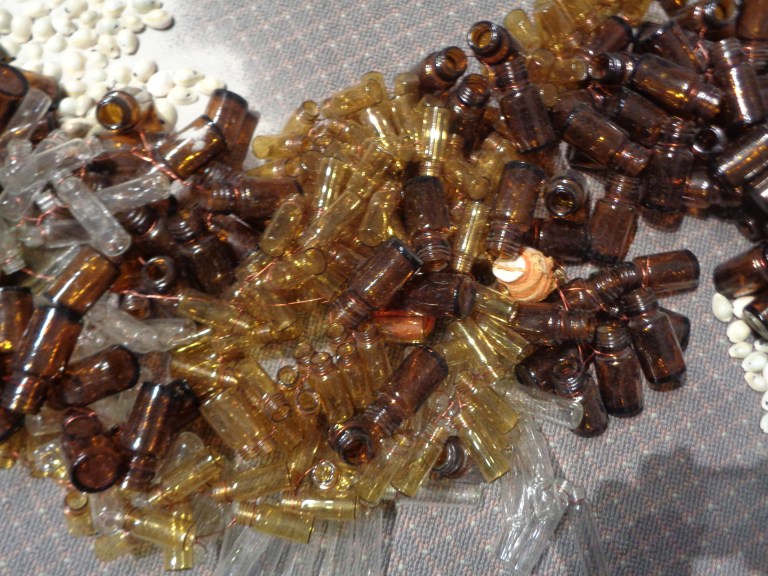

With breath taking consumption her commerce ate while she was being eaten
Glass vials, jute charpai (cot), shells, cotton thread, plastic skull, sari textile, 2008.
Rina Bannerjee, American born India 1963. Private collection on loan to this exhibition.


With Moon-shine and Money, she whistled her Siren’s plea. Her lizard’s tongue then only threw vines into sky of rupees, trick and tickles then you could see
Acrylic, ink, collage on paper, 2007
Rina Bannerjee, American born India 1963. Private collection on loan to this exhibition.
Citizens of the subcontinent have also to deal with the half-life of the British colonization of India.
The British took their Indian mirrors with them when they left the subcontinent. When these broke, their shards scattered all around the world.
Sub-continentals looking at themselves in these splinters find strange reflection of themselves which they sometimes are expected, unfairly, to explain.
Not South Asians alone but every culture ever colonized.


The Intellectual Explorer as a Underdeveloped Two Headed Man Pillaged and Parroted the Dreams of Natives. His Fruit was an Individual Identity
Ink, acrylic, enamel painting, on paper, 2008.
Rina Bannerjee, American born India 1963. Loaned to this exhibtion by the Centre Pompidou, Paris
The museum noted that tongues, intestines, digestive tracts stand for the consumption of commodities, cultures, identities as people circulate through the world.
The artist acknowledges our globalized economies and our global tourism in her work: she incorporates the raw and produced materials from dozens of countries.


The promise of self rule, played on her mind’s paradise, paralysed her curiosity and then only had she the will to erect her sitting beauty from sleep
Mixed media. 2008
Rina Bannerjee, American born India 1963. ? ownership.
Three portraits on the wall are of (N. American) Colonial women by Gilbert Stuart, 1755-1828, American
The gap between the artist’s Indian civilization and her adopted Western one shows up in Western criticism of her work.
One critic, Joyce Brodksy, says that this artist is milking Indian aesthetics, to feed Western desire for the foreign-beautiful-chimeric-dangerous-colourful-new.
Has anyone ever criticized a Western artist on similar grounds?
Did anyone tell Paul Gaugin to stop with the Tahitian exotica? The Impressionists to leave London fog and Thames glitter alone and go back to the River Seine?
And it took more than 100 years to point out the suspicious exoticism of Orientalism in Western painting and literature.


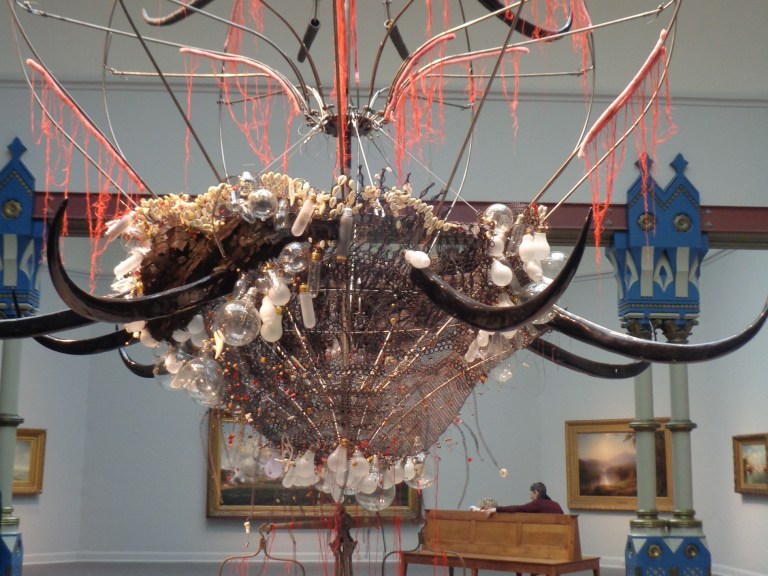
Winter’s Foul – Raw materials from sea andfromfoulandevenfrom someexotic mice was eaten by a world hungry for commerce mad these into flower, disguised could be savored alongside whitened rice
Oyster shells, fishbone, thread, cowrie shells, fur, deity eyes, copper trim, ostrich egg, epoxy, American buffalo horns, steel, fabricated umbrella structure, steel stand, pigeon-feather fans, 2009.
Rina Bannerjee, American born India 1963. ?Ownership
The artist, and all those of us finding our way between civilizations, enter liminal space.
Between worlds is liminal space: what was, was and what is to come is becoming and is not known.
One day in Ahmedabad, I came out in the early morning and found three women laying incense to burn in the center of the crossroads nearest my house.
To remove the danger inherent in travelling through crossroads for all travellers.
Peculiar was her manner, has an uncertain number of flaws….was she foreign
Ink, acrylic, on unbleached watercolour paper.2009.
Rina Bannerjee, American born India 1963. ?ownership
There is a possibility of change in the person making a path through liminal space.
Change to survive on the other side of the threshold; in a country in which you were not born and whose mores are not embedded in your base brain.


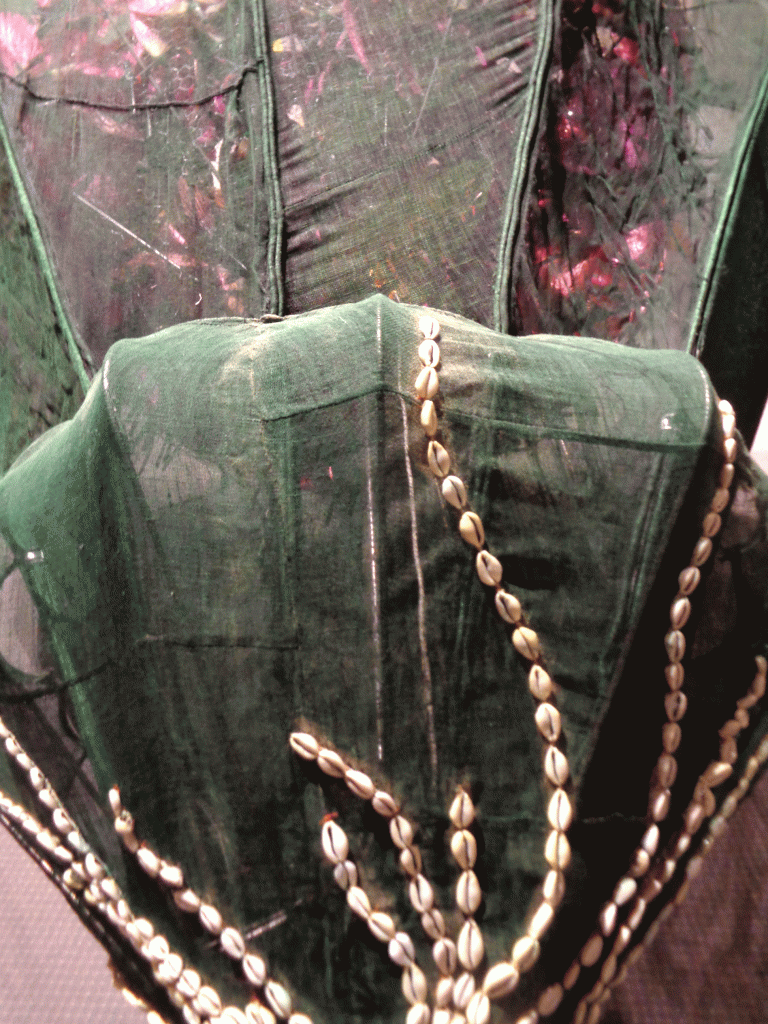


The world as burnt fruit – When empires feuded for populations and plantations, buried in colonial and ancient currency, a Gharial appeared from an inky melon – hot with blossom sprang forth to swallow the world not yet whole as burnt fruit
Feathers, cowrie shells, resin, alligator skull, globe, glass, vials, lightbulbs, steel wire, gourds, Japanese mosquito nets. 2009
Rina Bannerjee, American born India 1963. ? ownership.
For English-speakers looking at Rina Bannerjee’s art, her wordy story titles give insight into how hard and jarring this path can be.
An Asian friend of mine wished me ‘Happy Good Friday’ one year. She had wished the same to others and nobody had enlightened her of her misunderstanding and of one alternative meaning of the word ‘good’.


Little Red Riding Hood
Rooster, feathers, steel, knitted mesh, wood, rhinestones, deity eyes, wooden doll, mink fur, cowrie shells, thread. 2010.
Rina Bannerjee, American born India 1963. Private collection on loan to this exhibition.
The artist is zig-zagging between her worlds in these long titles. Syntax and grammar slipping from here to there.
Streams of word-images. A carapace, offering and antenna perhaps.
The Canadian-American poet Jack Kerouac, 1922-1969, no mean traveler himself, was one who walked this road before her and wrote about it in Old Angel Midnight (1956-59).
He explains why in liminal space ordinary consciousness is suspended and words and word-images begin to stream.


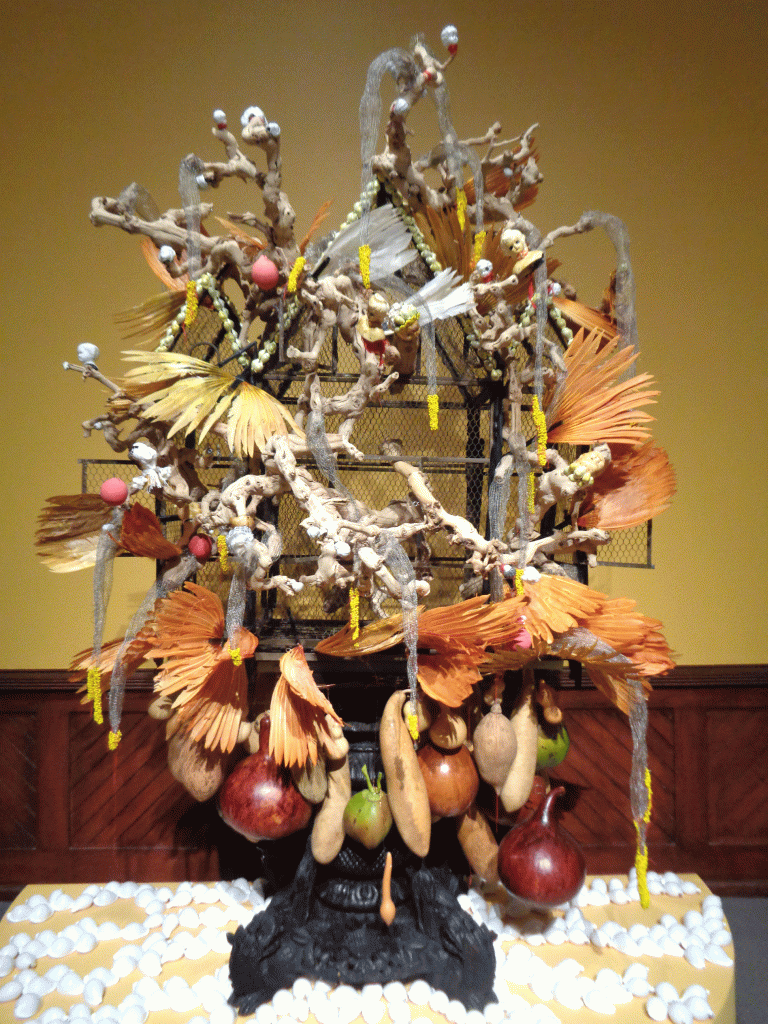


Her captivity was once someone’s treasure and even treasure but she blew and flew away took root which grew, we knew this was like no other feather, a third kind of bird which perched on vine intertwined was neither native nor her queen’s daughter, a peculiar other
Anglo-Indian pedestal of 1860, Victorian birdcage, shells, feathers, gourds, grapevine, coral, fractured Charlotte doll heads, steel knitted mesh with glass beads, Kenyan tourist sculptures, apple gourds. 2011.
Rina Bannerjee, American born India 1963. Loaned to this exhibition by the Cornell Fine Arts Museum

Mary McCall, c. 1746, oil on canvas. Robert Feke, c. 1707-1751, American. PAFA
Only one flower. No excess in Quaker Philadelphia!
“Old Angel Midnight is only the beginning of a lifelong work in multilingual sound, representing the haddalada-babra of babbling world tongues

“coming in thru my window at midnight no matter where I live or what I’m doing, in Mexico, Morocco, New York, India or Pakistan, in Spanish, French, Aztec, Gaelic, Keltic, Kurd or Dravidian, the sounds of people yakking and of myself yakking among,
“ending finally in great intuitions of the sounds of tongues throughout the entire universe in all directions in and out forever.
“And it is the only book I’ve ever written in which I allow myself the right to say anything I want, absolutely and positively anything, since that’s what you hear coming in that window… God in his Infinity wouldn’t have had a world otherwise — Amen.”

The song of a thousand flies and a sudden rage made her drop all her contents and stitch her veins to make them plain again
Acrylic, ink on paper. 2011.
Rina Bannerjee, American born India 1963. Loaned to this exhibition by a private collection
And there the poet is pointing up the attributes of this inter-cultural liminality:
Sapiens would not have survived without this kind of transformational change because the species is always on the move and this kind of change is fearful.
The liminal space is a cacophony.

Dodo Bird and her Extinction met Dutch sailors in the Indian Ocean while they were looking for fortune and existence both plain and simple into new world and paradises or experience death was one notion
Acrylic, ink, collage on watercolour paper. 2014.
Rina Bannerjee, American born India 1963. Loaned to this exhibition by the Ford Foundation.
This may drive some people mad and force others to retreat over the boundary they crossed. In rare instances it kills people.
But for many millions, such a space allows individuals to move forward in the maximum freedom of their semi-conscious minds. It protects the individual from landing too hard.
It allows them to do what Rina Banerjee is doing: go backwards and forwards tracing a way to re-self-definition.
On a path stepping now in one civilization, now in another, extracting, balancing, picking up from here and from there.
For every language is a treasury and every culture is a road map of a people’s investigation of how not to perish.
How to flourish.


She drew a premature prick in a fluster of transgressions, abject by birth she new not what else to do with this untouchable reach, unknowable body as she was an ancient savage towed into his modern present
Female mannequin form , amber bottles, epoxy American buffalo horns, steel arm brace, Benarasi Indian wedding sari trim, Victorian replica doll head, Indian jewelry, glass magnifying dome, replica deer eyes, wooden elbow bangles from the Congo. 2011.
Rina Bannerjee, American born India 1963. Private collection on loan to this exhibition.


Beauty was not in the East – her figure was in part a repellant I and his aura was not so neat. The locus of a pleasure stolen from deceit, stubborn and excessive the oriental was transformed in part as objects of sexual bad habits
Acrylic, collage on watercolour paper. 2013.
Rina Bannerjee, American born India 1963. Private collection on loan to this exhibition




Ruth St. Denis in the Peacock Dance, 1919, oil on canvas. Robert Henri, 1865-1929, PAFA, Philadelphia
The Orientalism continues to ornament the walls of our museums without anyone getting excited about feeding our need for exotic excitements.


A World Lost: after the original island appears, a single land mass is fractured, after population migrated, after pollution revealed itself and as cultural locations once separated did merged, after the splitting of Adam and Eve, shiva and shakti of race black and white, of culture East and West, after animals diminished, after the seas’ coral did exterminate, after this and at last imagine water evaporated….this after Columbus found it we lost it, imagine this. 2013
Mixed media. 2013
Rina Bannerjee, American born India 1963. Courtesy of the artist on loan to this exhibition.
So heartening this work:
in image and in word, Rina Bannerjee relays the path she is taking to flourish differently.
Infinitely rich for the possible ways of being human and of human beings.

Learn of their discovery, their complex physiological construction and fierce competition they grew attached and grew abnormally became lively with each other’s fondness for excitation
Acrylic on watercolour paper. 2013.
Rina Bannerjee, American born India 1963. ?Ownership


Make me a summary of the world! She was his guide and had travelled on camel, rhino, elephant and kangaroo, dedicated to dried plants, glass houses, for medical study, vegetable sexuality, self-pollination, fertilization, her reach pierced the woods, country by country
Wood rhino, Chinese umbrella, sea sponges, linen, beads, pewter, soldiers, grape vines, glass chandelier drops, acrylic horns, nylon and bead flowers. 2014.
Rina Bannerjee, American born India 1963. Loaned by the artist to the exhibition.

Photo courtesy of PAFA


Viola from New Orleans – ah, an African woman was the 19th century’s rescue worker, a global business good raker, combed, tilled the land of Commerce, giving America a certain extra extra excess culture, to cultivate it, making home for aliens not registered, made business of the finer, finer, had occupations, darning thread not leisure with reason and with luster, in peek-a-boo racial disguises preoccupied in circulating commerce, entertaining white folks, pulling and punching holes in barriers, place that where was once barren, without them, white banks made of mustard and made friendly folks feel home, welcomed and married immigrants from far noted how they also been starved, fled from servitude and colonial dangers, ships like dungeons, pushing coal in termite wholes, churning fire, but always learning, folding, washing, welcomed as aliens. She wandering, hosting, raising children connected to new mobilities and most unusual these movements in ‘Treme’, New Orleans was a incubated, enmeshed embedded in this silken cocoon when she land, she’s came to be a parachute mender, landed those black immigrant peddlers from Hoogali network of newcomers.
Murano glass horns, Indian rakes, seed beads, steel, yoruba African mask, oyster shells, cowrie shells, Charlotte dolls, polyester horse hir trim, Korean silks, Indian silks, vintage Kashmire shawls, French wire ferris wheel, Congolese elbow bangles, colonial mirror sconeces, Japanese seed glass beads, sequins, threads. 2017.
Rina Bannerjee, American born India 1963. PAFA, Philadelphia
There was a real woman, Viola Ida Lewis, who in 1906 married a South Asian immigrant, Joseph Abdin, from Bengal. Many Bengalis immigrated to the south of the United States to work in the steel and car factories.
Bengali families – called ‘peddlers’ – ran import businesses, bringing silks and embroidered fabrics such as those in this sculpture.

Photo from the site of Hosfelt Gallery

Flourish me different in wind and breezes and drift set sale always in motion and mindful adaptation, in not yet settled fertile selection, in open folds and ceaseless creases, in remote reaches this was wrinkled and snagged touched stopped with what nature teaches came to shed peel so these layers as evolution loosens makes us each time, every time this a tiny bit different
Rina Bannerjee, American born India 1963. Artist’s loan to this exhibition
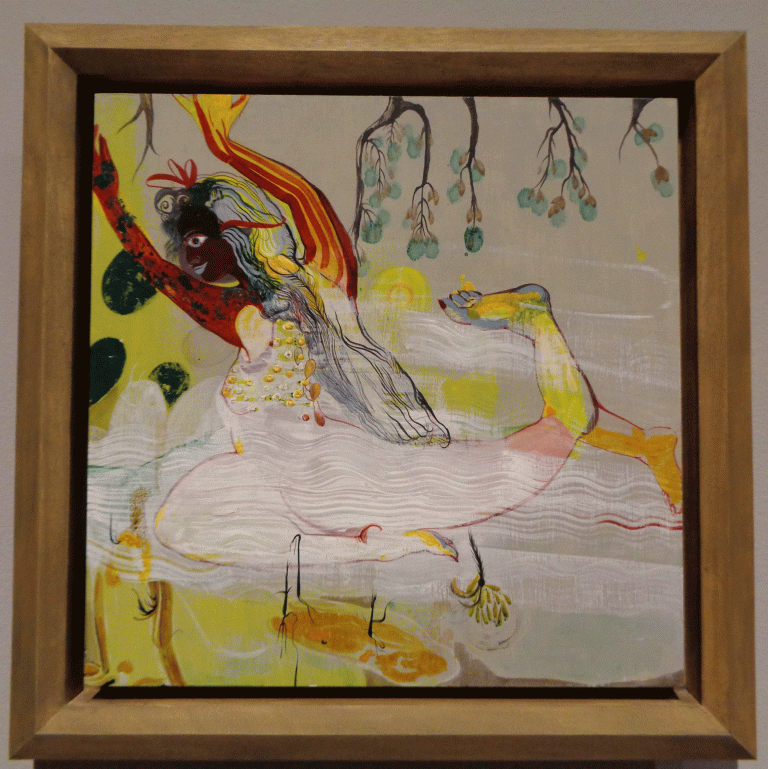

Ligaments wait to stretch in an identity that could double find home rubble find refuge in disguise
Silver leaf blue, ink, acrylic, on birch wood panel. 2015
Rina Bannerjee, American born India 1963. Private collection on loan to this exhibition.


In transparent soil she spoke to welome her other more mouthy voice, sliced open tunnel, mountain and air, tugged, tumbled even tackled to rise lighter, higher, more quicker knocking who?
Black ink, acrylic paint, crayon, gold and silver metallic paint, copper leaf, collage of marbled and other decorated paper, on paper. 2015
Rina Bannerjee, American born India 1963. Loaned by the Fine Arts Museums of San Francisco


Women do this in shining when her spare threads and vines crimped, wrinkled in lines could force a clear high shimmer of Bud, blue black flower all boney and new, will upon will, came with whispers of new
Mixed media. 2017,
Rina Bannerjee, American born India 1963. PAFA, Philadelphia.
What some women do now is make sculpture, like this artist, in whose native culture, as in so many others, sculpture is the preserve of men.


Tiffany Studios stained glass lancet windows of St. Cornelius and the angel, c. 1910


Excessive flower, hour by hour, banal and decorative, banished and vanished ofpower, reckless and greased she steals like jewel thieves, fierce, always in theater as actor, often captured in oils, thrown in air, robbed in vitality as death appears for all who have more colour – see her as unequal in sting to sun and processions of pomp if in marriage and funeral bearing in mind possessions of inheritance acquired
Mixed media. 2017.
Rina Bannerjee, American born India 1963. PAFA, Philadelphia
Stained glass lancet windows of Violet Oakley, 1874-1961, American: Wise and Foolish Virgins, 1908-09. PAFA, Philadelphia
Penelope, marble, 1891. Rinaldo Rinaldi, 1793-1873, Italian. PAFA, Philadelphia
With her basket of weaving materials with which she kept herself chaste against the return of her husband, Odysseus.


When sign of origin fade, fall out, if washed away, trickle into separations, precipitate when boiled or filtered to reveal all doubleness as wickedness. Vanishing act that migration, mixation like mothers who hid paternity who could name move me slowly reveal me only when my maker stands straight
Turtle replica in resin, vintage shell lampshades, steel armature, Polynesian mask, Pyrex filtration lab glassware, feathers, seed beads, pearls. Private collection on loan to this exhibition. 2017.
Rina Bannerjee, American born India 1963. Ownership?
Rina Bannerjee’s words are:
“Flourish me different in wind and drift and breezes set sale always in motion and mindful adaptation, in not yet settled fertile selection, in open folds and ceaseless creases, in remote reaches this was signaled and snagged touched stopped with what nature teaches came to shed peel so these layers as evolution loosens makes us each time, every time this a tiny bit different.”
Amen.
Dear Sarah, thank you so much for sharing this post.
You have introduced the wonderful works of an artist I did not know yet, who is able to express in a tangible way the state of mind of those who feel exiled, foreign, different…
Thank you for your sympathy with this subject, Luisa. I am also remembering how Gaza has been made an alien and hostile place. Sarah
Unfortunately, this is the case. And I fear that many places are becoming alien and hostile to an ever-increasing number of people, especially the less well-off.