
Chrysanthemums, grown in the conservatory of Longwood Gardens, PA (legacy of Pierre S. du Pont, American, 1870-1954).
were first displayed when the conservatory was opened in 1921. They are now usually annually on view in the autumn/winter.
The guidance of the Gardens is that early chrysanthemums were yellow. Natives of the Far East and also of north-eastern Europe, their greatest diversity is in China.


They have been bred over centuries for many colours, sizes and shapes of blooms.

A flower of a species of ?Heliconia pointing the way to an allee of chrysanthemums in the conservatory
Longwood Gardens’ collection includes specialty species of chrysanthemums which are kept in tissue culture to create this annual display.
Classification of chrysanthemums by the National Chrysanthemum Society (US) is by bloom shape. These are given evocative names like anemone; spoon; thistle; quill; spider; brush; and incurve.


Silver and gold chrysanthemum (Ajania pacifica), Japan


Anemone, Chrysanthemum x morifolium, ‘Yellow Vesuvio’

This Society has developed 13 classifications of chrysanthemums of which the thirteenth – see directly below – is satisfyingly called:
‘Exotic or Unclassified’.
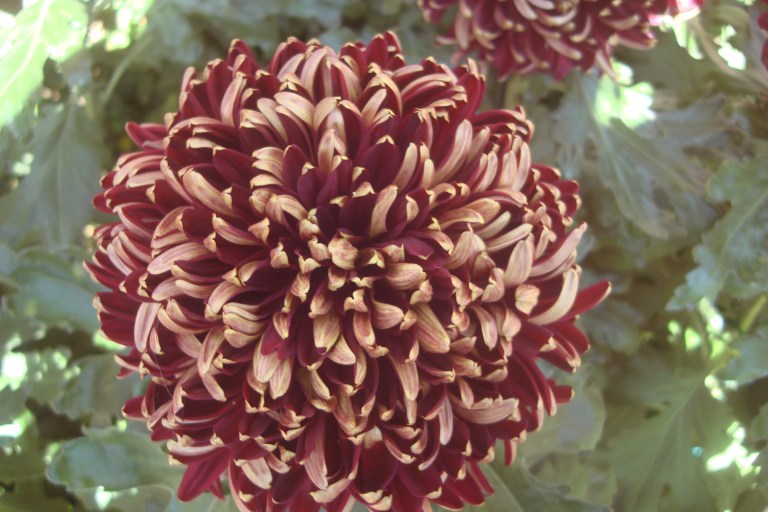
Blooms in this category often have twisted florets; or may exhibit characteristics of more than one classification; or of none of them.


Chrysanthemums in the Gardens at Petit-Gennevilliers, 1893.
Gustave Caillebotte, 1848-1894, French. Metropolitan Museum of Art


Still life with Chrysanthemums, 1862, oil on canvas.
Henri Fantin-Latour , 1836 – 1904, French. Philadelphia Art Museum




A Woman Seated beside a Vase of Flowers (dahlias, asters, gaillardias); 1865, oil on canvas.
Edgar Degas, 1834-1917. Metropolitan Museum of Art, NY
This painting, the subject of several poems, is also commonly called A Woman Seated beside a Vase of Chrysanthemums.
This painting is thought to be a homage to a friend of the artist at whose country house the artist had enjoyed flowers; and especially the company.
Chrysanthemum, dahlia, gaillardia and aster belong to the same family: Asteraceae
As always your images are wonderful: a symphony of glorious colors 🍁🍂