
Winterthur, Delaware, legacy of Henry Francis du Pont, 1880-1969, American
Sycamore Hill
2010-2025 except 2021
There are flowering plants in a wave across the park from late February through late October by design of its owner.
Its June flowering is on Sycamore Hill.
There Henry Francis du Pont found an American sycamore (Platinus occidentalis) already two hundred hundred years old, growing by a former stream bed.
In 1951 it was dying.
Consulting with arborists, he had it filled with 10 tons of concrete, whole train rails and other sundry metals.
It returned to life and its former magnificence.


the sycamore with its seed heads in winter

The sycamore in summer
More diverse and in a more complex design than other gardens in Henry Francis du Pont’s schema, Sycamore Hill comprises fragrant, flowering allees in late May and in June.
The pivot of this concentration is the sycamore tree which stands in the heel of an ‘L’ shaped formation of greenways planted with trees and bushes and flowers.
On the left side of the L and up its vertical leg is a meadow.

On the right side of the vertical leg and across the greenway is more meadow.
This is separated from the greenway by a fence which, following the shape of the L, also fences off the horizontal greenway from the same meadow.

Some of the few roses found at Winterthur are planted against the fence.


In some years a sheath of ivory grass is left to grow directly in front of the sycamore.


In other years, there are the mysterious June circles of the remains of daffodil beds which were in flower in April.

Sometimes you see people with their palms on the bark of the sycamore, holding still.

So immense is its girth and broad its shade; and unlikely its huge presence after near-death.
At the junction of the two greenways, you can sit with a stand of coniferous Arborvitae (Thuja accidentalis), a native tree whose name derives from the medicinal uses to which it is put by native Americans.


Arborvitae cultivars, called cypresses but not true ones
A few steps away, this extraordinary tree, sitting near the conjunction of the two greenways, tore itself apart over a period of years: a Japanese red maple which I never saw in leaf no matter what the season.


Japanese maple cultivar
It has been replaced by a native bush.


Smooth witherod cultivar (Viburnum nudum ‘Winterthur’) in late May
Further down the hill, a redbud is climbing the hill towards the sycamore. A split of its primary trunk gave birth to a third trunk, moving on the ground.


The greenway along the horizontal of the L is bleak in winter.

But it is also wide and harbours a significant number of trees and bushes, both native and non-native.


The horizontal L ends at the edge of an escarpment.

There is a gazebo there which is planted on one side with roses.

The gazebo sits underneath the boughs of a large tulip poplar (Liriodendron tulipifera), a native hardwood.
In the magnolia family, it produces small saucer flowers in yellow, cream and pale green in late May and June.


You can sit in the gazebo on the edge of the escarpment looking down to a body of water. There are foxes’ dens.

In years past, a tent was placed in the field below, behind a frieze of thistles.
Winterthur said the tent was of Ottoman inspiration.

The colour of the tent faded after a few years


but we believe it to be our favourite Indo-Saracenic.
Not far from the tulip poplar and also standing guard at the escarpment is a Western catalpa (Catalpa speciosa). It blossoms in June.

On the left, a tulip poplar and on the right a Western catalpa


Flower of the Western catalpa
Below and to one side of the tulip poplar, the last of Henry Francis du Pont’s gardens: the Quarry Garden;
It is filled with irises and candelabra primulas. It is fed by springs which flow out to that body of water.


candelabra primula in the Quarry Garden
The tree closest to the sycamore tree is a mature Kousa (Japanese) dogwood.


Kousa dogwood and its flowers in June

looking north up the vertical sward in June

looking north up the vertical sward in June from beneath the Kousa dogwood nearest the sycamore tree

a view of the vertical ‘L’
In late May and June, Sycamore Hill is transformed by its flowers.
The predominant colour is white; here and there enlivened with red, pinks, lilac, lavender.

A Kousa dogwood framed by an American fringe tree

Looking back towards the sycamore and the Kousa from the gazebo in June

The horizontal ‘L in June

Bushes of white Cottoneaster salacifolia


Japanese Spirea


Styrax obassia (Fragrant Snowbell)


Glenn Dale hybrid azalea behind weigelia


Deutzia crenata


Deutzia magnifica


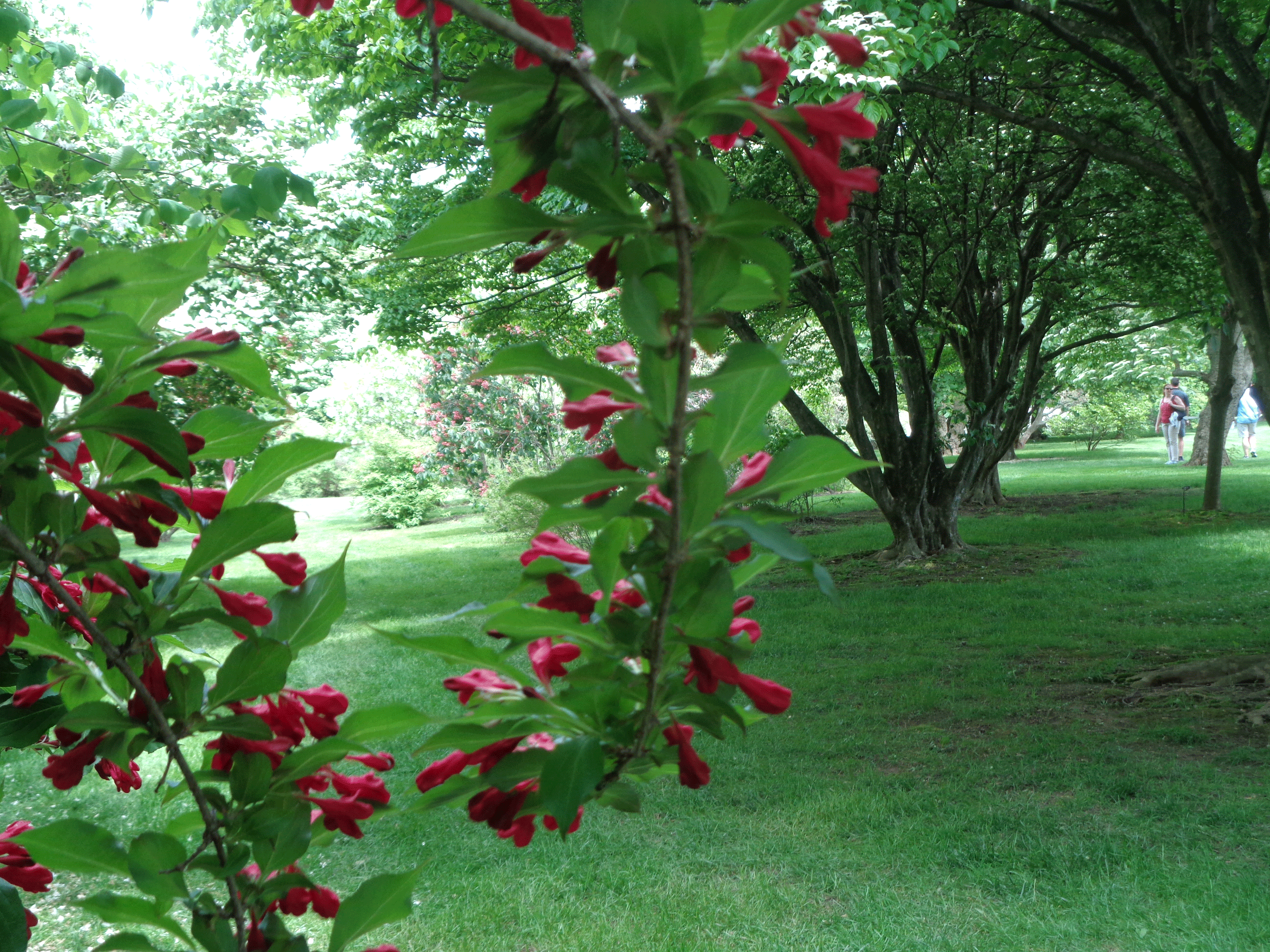

Weigelia


American Fringe tree. Fragrant at certain times in its flowering. Distinct but not overwhelming.

American Fringe tree (Chionanthus virginicus)


Kousa (Japanese) dogwood whose dense flowers seem to have made it more popular than native dogwoods

Weigelia framing a kousa dogwood


Deutzia cultivar


Garland Butterfly bush (Buddleia alternifolia)

Fragrant Abelia yet to open in mid-May

Fragrant Abelia in early June

Lilac is in bloom in June on Sycamore Hill


Japanese spirea
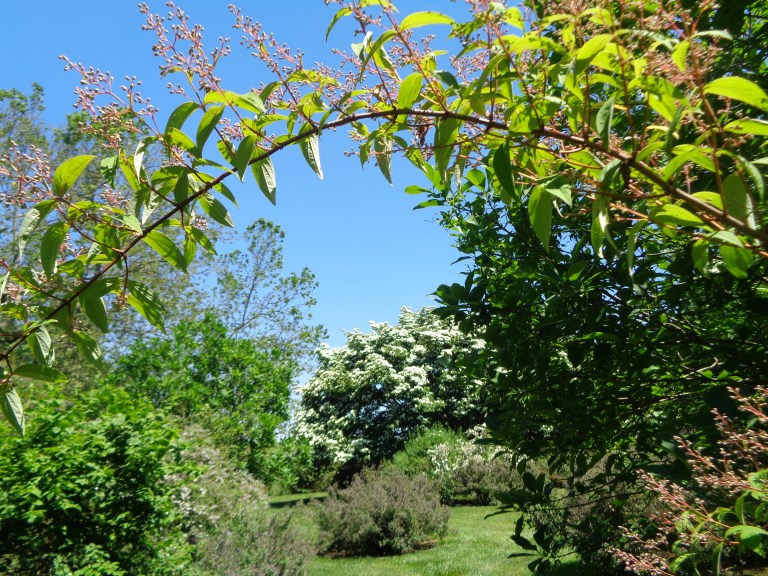

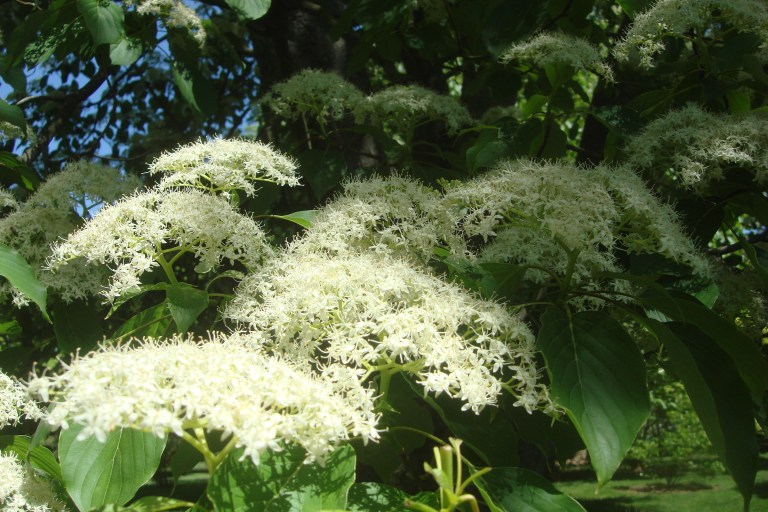
 Cornus alternifolia, a native dogwood


Oyama magnolia tree

Tea viburnum in two colours


American Yellowwood (Cladrastis kentukea)


Mock orange (Philadelphus)


Red buckeye


Mountain laurel (Kalmia latifolia)
When you leave Sycamore Hill, you walk some way into the park or down to the museum before you feel that you are beyond the draw of this immense tree, the old sycamore, accompanied in June by its garden of many flowers.


Thanks a lot for sharing, once again, a really interesting post with fabulous photos.
This site is simply wonderful!
Thank you for you always generous comments, Luisa.
Very good article
Thanks
Thank you!