
Judith Schaechter, American, born 1961
exhibited between 2015 and 2025 at the Philadelphia Art Alliance (closed), Philadelphia Art Museum, the Michener Museum, Doylestown, PA, the Pennsylvania Academy of the Fine Arts, Philadelphia; the Snyderman Gallery, Philadelphia (closed); and the Smithsonian American Museum of Art, Washington DC
These works – stained glass which has been cut, sandblasted, engraved, painted and fired – are some of the finest works of artistry and artisanal craft which I have seen.
The Philadelphia-based artist uses many images: realistic; mythic; floral (imaginary); faunal (imaginary); abstract; symbolic, every-day. These images she has harvested from the stories of ancient Greece/Rome, from the Bible, and from the scenes of our everyday lives.
Fragile, 1989


Some have described Judith Schaechter’s work as morbid, macabre, distressing, dark.
Her work has been accused of being ‘negative’ and ‘difficult’.
There is a very great emphasis in our civilization (North American) to be always upbeat, looking forever upward, projecting only positivity.
The artist, however, is in a tradition of realism. She is not in the North American philosophy of don’t worry-be happy!
There is no light without dark. We would not know what happiness is without sorrow.
And that is before we come to the difficult reality of how life eats life in order to live.
When the Hunter Sings, the Birds Take Wing, 1991


The artist addresses our lives ever slipping between apprehension, foreboding, fear, on the one hand, and uncomplicated happiness, comfort, wonder and everyday pleasure on the other.
Autobiography, 1999


Schaechter’s people are in transition between the tears of things and the loveliness of life.
We slip our whole lives into and out of the liminal passageway between these two states. Because everything changes all the time and we control so little.
It is our experience in this liminal space which is one of the artist’s major themes.
Liminality is an uncomfortable, unhinging state because your ego is in retreat and you are entering into vulnerability. (Unclothed as in so many of these images).
You would not be swinging from the chandeliers when you are there.
You close your eyes and still yourself. Your animal senses become acute. Your eyes become unfocussed. The blood drains from your face.
The next step you take is directed by your intuition and you step out of that solitary passageway back into the world.
The maturing of that intuition is the work of a life.
Schaechter’s images are of her creatures in the moments before that step.
You Are Here, 2008


An Invocation, 2009
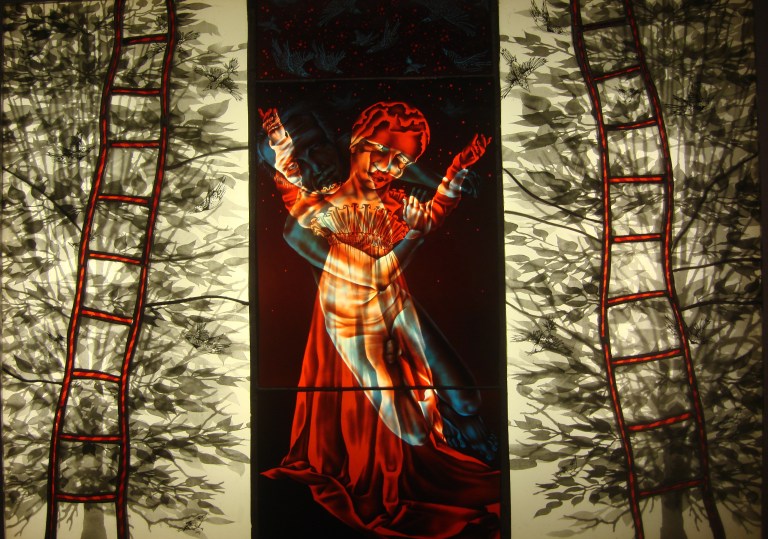
Muse
David Wagoner, American, born 1926
Cackling, smelling of camphor, crumbs of pink icing
Clinging to her lips, her lipstick smeared
Halfway around her neck, her cracked teeth bristling
With bloody splinters, she leans over my shoulder.
Oh my only hope, my lost dumbfounding baggage,
My gristle-breasted, slack-jawed zealot,
kiss me again.


The Minotaur, 2009


Prometheus, Noah, Mary Magdalene, 2011

The three in these three separate works, squeezed into these slits, like the openings in castle walls, are not awake.
The Battle of Carnival and Lent, 2011


There is a dissonance between the rich color and light of Judith Schaechter’s work and the threat and dread and strangeness rising off the glass from many of the images.
The dissonance is our discomfort that the radiant light of this stained glass is transmitting something different from that of the stained glass of our cathedrals despite the great beauty of the floral environment the artist habitually builds around her people.
Her people are hovering at the edge of dread. Often their eyes are closed in apprehension; perhaps in supplication or hope.
This dissonance has the same size and dimension as the requirement (in North American life) to be positive, upbeat, self-confident, fighting the good fight against the nasty exigencies of life quickly and efficiently.
The reality of life is often too complex, too muddy and mixed-up, too full of the inequalities of our wo/man-made world, and the acts of Fate to eventuate in life-conquering positivity.
The artist is particularly sensitive to what women know of their own lived experience which may or may not mesh with what they are expected to say, live and feel.
Our Ladies, 2012


Acedia, 2013 (acedia = spiritual or mental sloth or apathy)


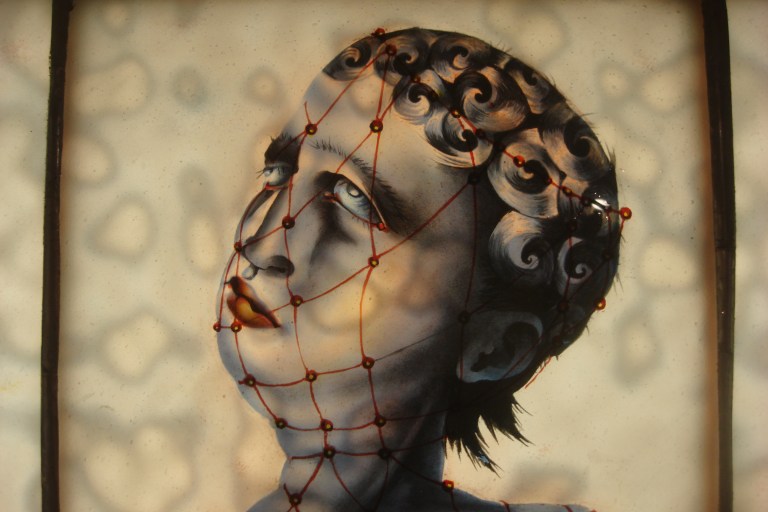


The sky above is filled with diffuse sunlight.
The earth below is crammed with wonder.
But the figure, ensnared in a mesh net of the blood of others, has drained the blood of everything around her and turned even the birds to wraiths.
The Birth of Eve, 2013


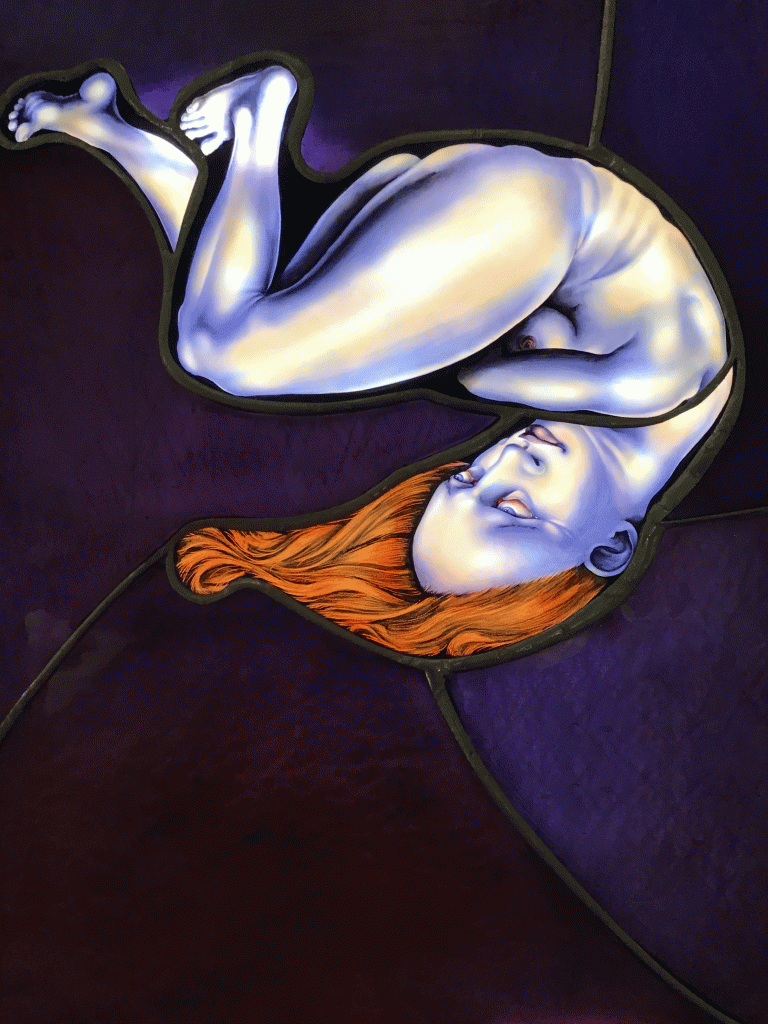


Harpy, 2013


Schaechter’s second theme is the natural world and our alienation from it.
Three-tiered Cosmos, 2105


Her arms behind and under her, a woman dreams.
Persephone, 2015


Persephone – archetype of the dutiful daughter – descending to Hades at the beginning of Autumn in a deal brokered by Jupiter.
She rejoins her mother, Demeter, on the surface of the earth at the beginning of Spring.
The artist referenced a poem as inspiration. It is by A.E. Stallings (American born 1968): Persephone Writes a Letter to Her Mother from which this is an extract:
I miss you and think about you often.
Please send flowers. I am forgetting them.
If I yank them down by the roots, they lose their petals.
And smell of compost. Though I try to describe
Their color and fragrance, no-one here believes me.
They think they are the same thing as mushrooms.
Horse Accident, 2015


The girl has slipped off the horse’s back. The horse has been startled by a monstrous, predatory canine.
But she, her right hand clenched in tension and her left open in either supplication or acceptance, or both, is dreaming. Perhaps the accident interrupted her journey to a fate she did not choose.
Her head is lifted to the sun. There is a slight smile about her mouth. She is not suffering.
The Life Ecstatic, 2016


“I found the beauty of glass to be the perfect counterpoint to ugly and difficult subjects”, the artist has said.
And on the composition of her rich backgrounds, she has pointed to their providing a “possible psychological state, a hallucination, a dream…”
Real Life, 2016


Philadelphia is a center of Realism in art.
3 major themes of the Realist tradition in painting – figure, still life, and landscape – are seen within one frame. The artist points to the fact that the only reference to nature for many is in a created image.
Isola, 2017,


A woman experiences her life as a loneliness despite the abundant life in which she lives.
Schaechter’s work evokes mystery, fear and dread; and supplication for protection; and unanticipated, pleasurable surprise.
Human Nature, 2017


The artist points to the oddness – from a certain viewpoint – of our love of cut flowers but not, for many of us, of their natural environment of which we may know little.
The Meadow, 2017 (image from the artist’s website)

She invokes a natural world: fantastic, fecund, fragrant, stable in its ever changingness.
Murdered Animal, 2019

Murdered Animal was inspired by a seventh century Assyrian low-relief sculpture of a lion hunt. She places the fate of the animal in the center.
It is also a memorial for the artist’s cat, Siouxsie.
Over Our Dead Bodies, 2020


Dirty Snow, 2021


A woman carries a plastic bag of the faeces she has scooped up off the sidewalk after a walk with her dog whose leash can be seen.
This image comes from the artist’s walks around her neighbourhood during Covid 19. Her meaning is that we are all carrying baggage.
Axe-Wielding Maniacs, 2021

Deforestation; thoughtless environmental degradation. Some of these figures are aiming their axes at each other and the artist is also pointing to male rage and virulent masculinity.

Partial preparatory drawing
Technique
The artist’s technique is time-consuming and meticulous. This is adapted from the website of the Chrysler Museum of Art and the artist’s own words available on You Tube.
The artist sketches her design.
She diagrams how to cut and fit together the pieces of glass.
Using a steel-wheel cutter, she cuts the glass.
The glass is hand-blown flash glass: pale or colourless glass with a paper-thin thin veneer of pale or vibrant colour.
She further refines the shapes using pliers. She grinds all edges of the glass until smooth.
She abrades the surface of the glass by sandblasting. This allows colours beneath the surface colour to show and creates space for detail work.
The artist uses permanent marker to draw her images onto the glass. Diamond-tipped tools are used to create tonal variations in the flash glass.
The colour of the glass overwhelmingly is the colours of the flash glass the artist has used.
Black enamel is painted on and fired in a kiln at 1250˚ F. Each piece of glass is usually fired twice or three times in order to achieve rich blacks and tonal variations.
Sometimes, a light wash of yellow (silverstain) and fuchsia transparent enamel are painted onto the glass The use of red and blue glass, combined with small amounts of black, yellow, and pink enamel, produces a full-color spectrum within a single section of glass.
The entire creation is polished either with heat in a kiln or by an application of acrylic varnish.
Flash glass panes are stacked – up to five layers deep – one on top of another to create vibrant hues of oranges, pinks, purples, greens.
Thin copper foil is wrapped around the edges of each piece of glass, which are then soldered together.
On rare occasions, the artist joins the glass pieces with traditional lead strips of lead instead of copper foil.
To make a light box, the work is placed in a zinc frame and fitted with a light source for illumination.
Swarm, 2023 (from the artist’s website)

Super/Natural, 2023-2025
In 2023/24, Judith Schaechter was the artist-in-residence at the Penn Center for Neuroaesthetics in Philadelphia, founded and directed by Dr. Anjan Chatterjee. The center, a subdiscipline of the cognitive neurosciences, focuses on three broad areas: beauty and morality; the built environment and wellness; and engagement with art.
During her time in residence, the artist built a biophilic dome (from ‘biophilia’, a word coined by the psychoanalyst, Erich Fromm, whose definition was:
“a passionate love of life and of all that is alive…whether in a person, a plant, an idea, or a social group”.)
The dome represents a three-tiered cosmos.
At eye level is the earthly domain.
Below are a ten-panel ‘under world’ in red-browns.
The geodesic dome above contains 45 triangular panels: stars, birds flying to a vanishing point.
The only human figure is the one who stands or sits in this dome.
Super/Natural is a plea to rekindle what is thought to be a native human attribute – attenuated by the teaching of generations of our Western culture and history – to identify with and come to know and guard and love the processes of our natural environment and simultaneously of our own nature.

Stained glass by Judith Schaechter. Woodwork by Patrick Murray and Kyrue Walker.
The photo above is from the artist’s website
Of biophilic design, Schaechter has said:
“….it seems biophilic design offers an opportunity to reconcile human consciousness with the environment. It challenges the perceived divide between mind and body, person vs nature, as well as the mental distinction between ‘interior vs. exterior’ or ‘self versus not-self’, revealing it as a perceptual illusion…..
“My goal was to create something that ‘heals’ this divide.


“…By situating the viewer at the center of a three-tiered cosmos, Super/Natural invites contemplation of both inner space—how we experience environments neurologically and psychologically—and outer space—how we extend ourselves into our surroundings.
“I aimed to inspire reflection on our interdependence with all life on Earth, encouraging an internalized sense of connection akin to viewing the “blue marble,” from within rather than from the far-off perspective of outer space.
“We are ultimately connected to, not just observing nature.”


“…As a stained glass artist, I am acutely aware that my work is exhibited in lightboxes, not in churches and temples as is traditional.
“Thus, I have thought for years that I would like to make a ‘personal shrine’ for a single viewer. This goes against the convention of thinking in the monumental terms suggested by cathedrals as well as many contemporary art venues.”
“Western culture tends to revere the huge and sublime while undervaluing the small, intimate….This preference for grandeur creates physical and psychological distance between the viewer and the stained glass. I sought to collapse that separation.
“Moreover, stained glass in churches and public spaces is almost always designed for a collective audience.
“In the age of mass media, there’s a temptation to assume that reaching the largest number of people is inherently better. Super/Natural challenges that notion by offering a semi-private experience.”

“When we despair,” Schaechter has said, “it is beauty that saves us, not reasoning and logical argument.
The capacity for beauty in the human brain as it interfaces with nature is a marvelous and life-affirming thing.”
<3
I didn’t know this artist and I thank you for talking about her and her interesting technique.
I found her works really beautiful, realistic, sometimes a little disturbing… but they represent life as it is, without sugarcoating or embellishing it, don’t they?
Thanks for looking, Luisa.
For reasons best known to Judith Schaechter, she is unafraid of pointing to the gap between what we are and what we are expected to be. The pressure to conform to beauty standards – as one example – has become even more acute now with online streaming and ‘influencers’ of all kinds! I very much appreciate this work!