
Works from the Exhibition: Soul of A Nation: Black Art in The Era of Black Power in 2018 and 2019 at the Brooklyn Museum, NY
The Tate Modern, London organized this exhibition to display the works of artists who came of age during and after the introduction of the Civil Rights Act (1964) and the Voting Rights Act (1965)
I have added other work from this time period (1963-1985).

Unite! 1971, screenprint on paper.
Barbara Jones-Hogu, 1938-2017, American. Private loan to the Brooklyn Museum in 2018/19
The artist co-founded AfriCOBRA (African Commune of Bad Relevant Artists) in 1968 in Chicago. AfriCOBRA was about representing the visual expressions of the African diaspora in the belief that artistic expression can drive social change.
She was a member of its predecessor Organization of Black American Culture (OBAC), founded in 1962.
She also involved herself in the Southside Community Center, Chicago.
It has been and is difficult to see works of minority artists because very few are in the collection of museums, universities or other institutions. Most of these artists have had mean institutional support. A minority of this minority is now nationally prominent.
This exhibition was a review of figurative and conceptual work in painting, mural, collage, prints, sculpture, fabric arts reviewed for their aesthetic innovations;
and also in four geographical areas: New York, Chicago, Los Angeles, and Washington DC.

All Power to the People, 1970, cut and pasted coloured paper, pencil and presstype on paper.
Faith Ringgold, 1930-2024, American. Private collection loan to the New Museum, NY in 2022
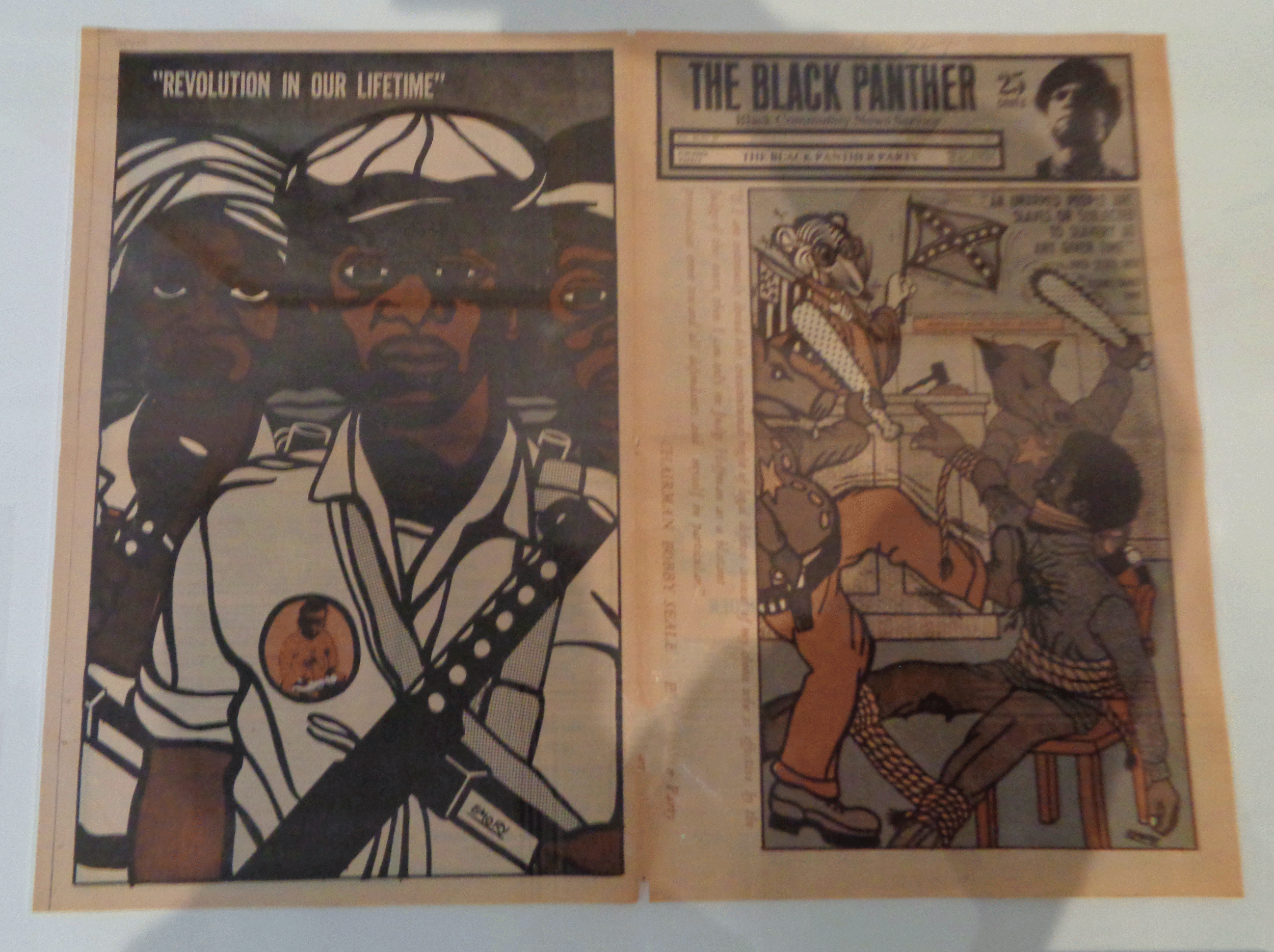
Revolution in Our Lifetime, 1969, lithograph on paper.
Emory Douglas, American born 1943 whose his title was Minister of Culture, Black Panther Party
Not all the works contain political content.
Some artists did not believe in a ‘Black aesthetic’.
Some artists painted portraits of their people, widely viewed for the first time in the history of this community.
Narration, representation, portraiture, exhortation, education, community organization and support of artists.

Brother James, 1968, oil on canvas.
James Brantley, American born 1945. Pennsylvania Academy of Fine Arts, Philadelphia
A self-portrait, wrapped in a soiled American flag, after the artist returned from service in Vietnam.


J.S.B. III, 1968, oil on canvas (James Brantley)
Barkley L. Hendricks, 1945-2017. American. Pennsylvania Academy of the Fine Arts, Philadelphia
There is now more minority work exhibited and bought by institutions. This took on added urgency after the murder of George Floyd on a Minnesotan street in 2020.
The groundbreaking work of the Souls Grown Deep Foundation is bringing focus on the artistic expression of self-taught African American populations in the deep rural South; and on the need for the institutional inclusion of curatorial perception from minority populations.


Smoke-Filled Sky (You Can Burn a Man’s House But Not His Dreams, 1990, charred wood, industrial sealing compound, and paint, mounted on wood.
Ronald Lockett, 1965-1998, American. Philadelphia Art Museum.
These changes are important considering that we are now, again, in a period of governmentally-initiated impoverishment – in many spheres – of the lives of minority populations. All minorities.
——————————-
Chicago
Black artists on the South Side of Chicago came together in 1962 to support the political struggle in an organization they named The Organization of Black American Culture (OBAC).
In 1968, after the assassination of Martin Luther King, a number of OBAC artists formed the African Commune of Bad Relevant Artists (AfriCOBRA) because they wanted a more direct impact on the liberation movement.
Their aesthetic was one of bright colours for strong impact.


Say It Loud, 1969, acrylic paint on linen, and detail.
Gerald Williams, American born 1941. Private loan to Brooklyn Museum in 2018/19

Brothers Surrounding Sis, 1970, acrylic paint on suede.
Jae Jarrell, American born 1935. On loan by the artist to Brooklyn Museum in 2018/19


Uhuru, 1971, screenprint on paper, and detail.
Nelson Stevens, American born 1938. Private collection on loan to Brooklyn Museum in 2018/19

Liberation Soldiers, 1972, acrylic oil and foil on canvas.
Wadsworth Jarrell, American born 1929. Private collection on loan to the Brooklyn Museum in 2018/19
This was shown at the Studio Museum in Harlem in the second AfriCOBRA exhibition in 1972. Huey Newton is front left and Bobby Seale on the front right.


Black Prince, 1971, acrylic paint on canvas, and details.
Wadsworth Jarrell, American born 1971. Private collection on loan to Brooklyn Museum in 2018/2019

Revolutionary, 1972, acrylic paint and mixed media on canvas.
Wadsworth Jarrell, American born 1971. Brooklyn Museum, NY in 2018/19

Wives of Shango, 1971, acrylic paint, gold and silver foil on cardboard.
Jeff Donaldson, 1932-2004, American. Smithsonian Museum of American Art on loan to Brooklyn Museum in 2018/19
Oshun, Oba and Oya, the three wives of Shango, the Yoruba god of thunder.
The artist was a driving force in the arts community in Chicago and later long-time Howard University professor and dean of its Fine Arts College.

Black Children Keep Your Spirits Free, 1972, acrylic on canvas.
Carolyn Mims Lawrence, American born 1940. Family collection on loan to Brooklyn Museum in 2018/19


Uphold Your Men, 1971, screenprint on paper, and detail.
Carolyn Mims Lawrence, American born 1940. Private collection loan to Brooklyn Museum in 2018/19
The Wall of Respect, an outdoor mural was one of the largest projects of the Organization of Black American Culture (OBAC).
The Wall featured prominent Blacks in politics, the entertainment and the sports worlds. The Wall functioned as a meeting place and inspired murals in many communities nationwide.
Among its most successful successors is the Mural Arts Program in Philadelphia.
Begun in 1986 by Jane Golden, it has created approximately 3000 murals by communities and grafitti artists and students and mural artists to commemorate the city’s history, peoples, and communities.
Gentrification and new building inevitably erase some of these murals.

‘Freedom School’, 31st and Gerard, Philadelphia,
Parris Stancell, 2002 for the Mural Arts Program, Philadelphia


A remembrance of the African-American intellectual and sociologist, W. E. B. Dubois (1868-1963, American) and his groundbreaking study The Philadelphia Negro, published in 1899.
Philadelphia Mural Arts Program, 8th and South, Philadelphia
———————————–
Figuration, Abstraction, Conceptual Art
The Black Community of artists was as taken up as any other by the large art stylistic battles of the day.


Red Atmosphere, 1973, acrylic on canvas.
Alma Thomas, 1891-1978, American. Tougaloo College Art Collection, Mississippi loan to the Phillips Collection, Washington, DC in 2021/22
A Washington, DC-based artist associated with the Color Field artists, Thomas did not usually participate in public political action.
She did, however, participate on the March on Washington and was a mentor and guide to young artists.
With, for many but not all artists, there was one added layer of complexity: the question of which style best served the purpose of the liberation of their people.

Title Unknown (March on Washington), 1965, oil on fiberboard.
Norman Lewis, 1909-1979. Current location unknown
An Abstract Expressionist of the first hour, the artist did not receive the recognition or rewards of his famous peers.
The styles adopted covered the wharf.

The Dove, 1964, cut-and-pasted printed paper, gouache, pencil, and colored pencil on board.
Romare Bearden, 1911-1988, American. MOMA, NY


Sphinx Alley II, 1975, acrylic on canvas, and details below.
Jack Whitten, 1939-2018, American. National Gallery of Art, Washington, DC
In 1971, the artist said: “I removed all spectrum colour from the studio: all reds, blues and yellows. I took them out! I reduced them down to black, white, and a range of grays. You have to understand that getting rid of all the chroma and taking it to black and white is not just a formal exercise.
“I am very much aware of the meaning of black and white in American society, which informs who I am as an African-American. The formal reasons of black and white is one thing but there are also the reasons coming out of the political situation, and I wanted to see if I could combine them.”


Elijah, 1969, etching and drypoint.
Charles White, 1918-1979, American. Metropolitan Museum of Art, NY
The doyen of African-American painters of his time, White taught several artists still at work today.


Masking Myself, 1972, ink and market on paper.
David Driskell, 1931-2020. Loan from the Bowdoin College Museum of Art, Brunswick, Maine to the Phillips Collection, Washington, DC in 2021/22
David Driskell: artist, art researcher, exhibition-organizer, teacher, a huge booster of the art of the African American community wherever they were in the United States.


Jack Johnson, 1971, oil on canvas and detail.
Raymond Saunders, American born 1934. Pennsylvania Academy of the Fine Arts, Philadelphia
The artist painted both figuratively and in abstraction. He rejected the idea of a Black aesthetic.
Jack Johnson was the first African-American heavyweight boxing champion. Rioting followed his victory in 1910 in which a number of Afro-Americans died at the hands of white mobs. In 1913, an all-white jury convicted Johnson of transporting a white girlfriend across state lines in contravention of a law designed to stop immigrant prostitution. Johnson served 366 days in prison.
The armlessness of this portrait refers to this sorry history of the racism which destroys lives.
Repeated appeals to US presidents for the pardoning of Johnson failed.
President Trump finally pardoned him, upon the request of the actor Sylvester Stallone and others, on May 24, 2018.

American Girl, 1974, etching and aquatint.
Emma Amos, 1937-2020, American. Philadelphia Museum of Art
Every time I think of colour”, the artist said, “it’s a political statement.”
Her work went significantly unrecognized in her lifetime.

Anthem, 1972, ink on paper.
Roland Ayers, 1932-2014, American. Exhibited at the Woodmere Museum in 2023


Family, ink on paper, 1972.
Roland Ayers, 1932-2014, American. Exhibited at the Woodmere Museum in 2023

Untitled, 1978-80.
Ed Clark, 1926-2019, American. Brooklyn Museum of Art

April 4, 1969, acrylic paint on canvas.
Sam Gilliam, American born 1934. Smithsonian Museum of American Art on loan to Brooklyn Museum in 2018/19
A Washington, DC-based artist and one of several who stained canvasses in this manner.
This was a remembrance of Martin Luther King, Jr. one year after his assassination


Untitled #32, 1935-2005, mixed media.
Al Loving, 1935-2005, American. Perez Art Museum, Miami on loan to the Brooklyn Museum in 2018/19

LeRoi Jones and His Family, 1964, oil on canvas.
Bob Thompson, 1937-1966, American. Hirshhorn Museum and Sculpture Garden, Washington DC on loan to Brooklyn Museum in 2018/19. Image from the web.
The poet and activist with his first wife, Hettie Jones, and their two daughters one year before the assassination of Malcolm X broke up this family and altered all their lives.


Homage to Malcolm, 1970, acrylic on canvas, and details.
Jack Whitten, 1939-2018, American. Private loan to Brooklyn Museum in 2018/19
Several colours of paint laid down and combed with a hair comb.


Texas Louise, 1971, acrylic paint on canvas, and details.
Frank Bowling, British born Guyana 1934. Private collection on loan to Brooklyn Museum in 2018/19
The artist was born in Bartica, Guyana before moving to England and then New York.
He argued for the widest aesthetic including both representation and abstraction. He himself drew from Colour Field ideas: he poured waves of acrylic paint over stencils of continents before removing them to apply more paint.


Bartica Born, 1968, acrylic paint on canvas, and detail.
Frank Bowling, British born Guyana 1934. Private collection on loan to Brooklyn Museum in 2018/19


View of Self, 1978, stain on red cedar and mahogany.
Martin Puryear, American born 1941. Joslyn Art Museum, Omaha on loan to Brooklyn Museum in 2018/19.
The sculpture is hollow. The artist said that is meant to visualize the secret self; anyone’s and not of that of someone in particular.

A view of a gallery in the exhibition


Sir Charles, alias Willie Harris, 1972, oil on canvas.
Barkley Hendricks, 1945-2017, American. National Gallery of Art, Washington, DC.


What’s Going On? 1974, oil paint, acrylic paint and acrylic resin paint on canvas, and details.
Barkley Hendricks, 1945-2017, American. Private collection loaned to Brooklyn Museum
The title is taken from Marvin Gaye’s protest song about so much ambient violence both in the United States and also in Vietnam where there was what seemed unending war.
The artist is best known for his elegant portraits. This one is part fictional and part portrait of living people: the woman his long-time model, Adrienne Hawkins; and the young man with glasses his brother.

Brilliantly Endowed (Self-Portrait), 1977, oil and acrylic on canvas.
Barkley Hendricks, 1945-2017, American. Private collection loaned to Brooklyn Museum. Photo from the net.

Blood (Donald Formey), 1975, oil and acrylic paint on canvas.
Barkley Hendricks, 1945-2017, American. Private collection loaned to Brooklyn Museum in 2018/19

A view of a gallery in the exhibition


Asa’s Palace, 1973, acrylic on canvas, and detail.
Jack Whitten, 1939-2018, American. Private collection on loan to Brooklyn Museum, 2018/19

Three Spades, 1971, bodyprint and screenprint on paper.
David Hammons, American born 1943. Glenstone Museum, Potomac, Maryland on loan to Brooklyn Museum in 2018/19. Image from the web
‘Spade’ is a derogratory word for Black people.
The artist began making body prints in the late 1960s in Los Angeles: he would cover himself in grease and press his body, limbs and face on sheets of paper before covering it with pigmented dust.

Bag Lady in Flight, reconstucted 1990, shopping bags, grease and hair.
David Hammons, American born 1943. Eileen Norton Harris Foundation on loan to Brooklyn Museum n 2018/19

Masked Taping, 1978-79, gelatin silver prints
Senga Nengudi, American born 1943. Exhibited at the Philadelphia Art Musuem in 2021. Photo by Adam Avila taken from the net
The artist taped small pieces of paper all over her body and said that, moving thus adorned, she experienced the sensual sensation of the tape on her body; she explored her African heritage of mask-making, rites and dance; she continued her fascination with paper and its uses.


Leaning, 1989, 32 bundles of wire rope and wire
Maren Hassinger, American born 1947. MOMA, NY


Beauty is in the Eye of the Beholder, 1979, acrylic on canvas.
Robert Colescott, 1925-2009, American. Loaned to the New Museum, NY by Portland Art Museum, Oregon in 2022
The artist is working on a copy of Henri Matisse’s 1910 painting, La Danse. Distracted, he turns to look at a woman only partially dressed.
Colescott explained that this is a representation of his creative process: on the one hand the imagination and on the other reality.


Flight Fantasy, early 1980s, records, reeds, string, hair.
David Hammons, American born 1943. Private collection on loan to Brooklyn Museum in 2901/19


Close Your Eyes and See Black, 1969, pigment on gold-coated paperboard (with light interference).
David Hammons, American born 1943. Solomon R. Guggenheim, NY.
Thank you for sharing this fabulous series of artists and artworks🙏🙏🙏
It was a compelling, rich and varied post and, as always, it fascinated me.
By now I have run out of adjectives to express all my appreciation, dear Sarah
Thank you for your ever appreciation, Luisa.
Our lives are so rich and I am so fortunate to be able to harvest some of the images of this bounty!
Thank you again, dear Sarah, for your gracious reply and for your impacting share! ❤️
Thank you for sharing this fabulous series of artists and artworks 🙏🙏🙏
It was a compelling, rich and varied post and, as always, it fascinated me.
By now I have run out of adjectives to express all my appreciation, dear Sarah
I stumbled here on accident – this is a fab repository
Thanks for looking and commenting!