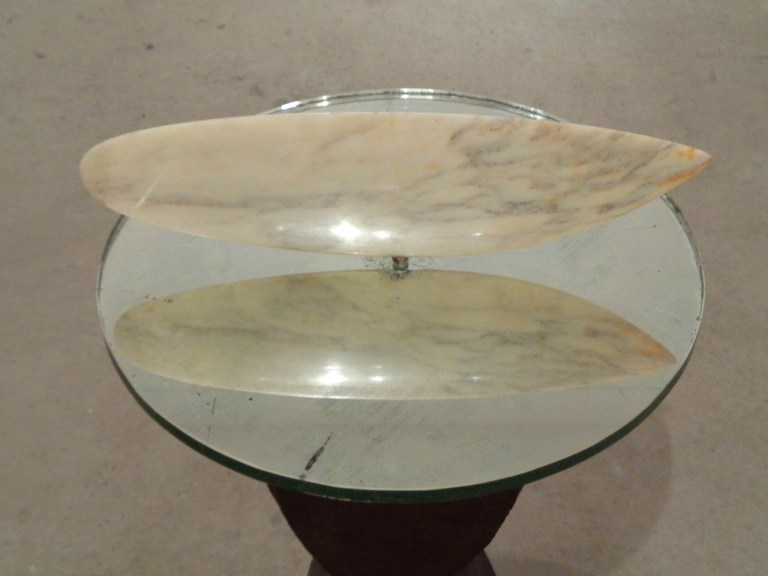
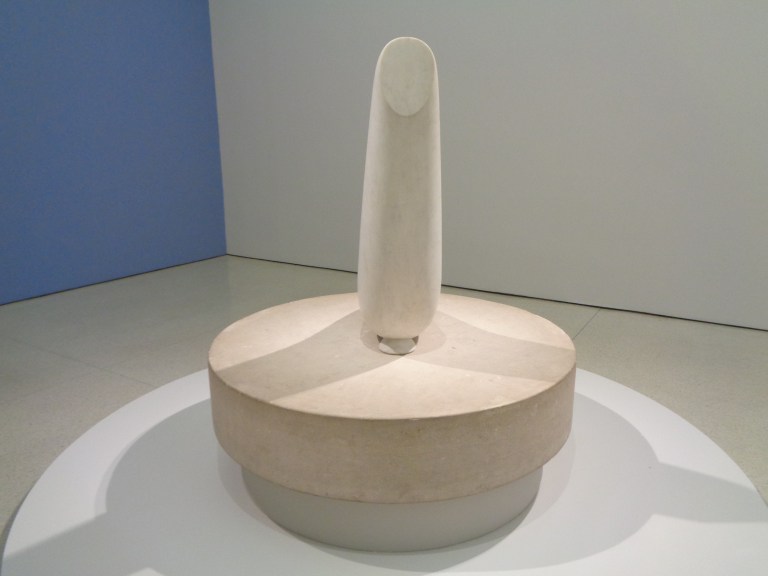
Constantin Brancusi, Romanian, born 1876, Hobitza, Romania; died 1957, Paris, France
Brancusi, of peasant stock, left home at 11, worked here and there, studied at a number of places and reached Paris in 1904 mostly on foot for more study and apprenticeship when he was in his late 20s.
From then on, it is as though, with the realism of the European sculptural tradition at his back, and of Rodin all around him at his (Rodin’s) peak,
Despair, modeled by 1890 and cast by 1906, marble.
Auguste Rodin, 1840-1917, French. Philadelphia Art Museum
Brancusirode his own highway to the liberation of sculptural form from realism;
to the simplified, reflective, shining shapes of a limited number of forms.
He started with limestone in 1907; 1908: marble; in 1911, Brancusi cast from marble into bronze. In 1913 he first used the wood of which he was so fond.
Brancusi did not consider his work abstract. He said:
“What is real is not the external form, but the essence of things.”
You wonder if this is far different in intent from Paul Cézanne‘s
influential liberation of the mass, form, substance of an object, person or landscape from its enmeshed objective reality
to emphasize our subjective perception of that very mass and solidity, made more massive and more solid but without entering into abstraction.
Woman with a Coffee-maker, 1895, oil on canvas.
Paul Cézanne, 1839-1906, French. Musée d’Orsay on loan to the National Gallery of Art, Washington, DC in 2018
The Garden at Les Lauves, 1906, oil on canvas. Acquired 1955 by the Phillips Collection.
Paul Cézanne, 1839-1906, French. Phillips Collection, Washington, DC
The sources ofBrancusi’s inspiration included Romanian folklore and the ritual sculptures of pre-industrial societies available for viewing in Paris.
I imagine that we shall never know all the sculptor’s sources because he was born and raised in a rurality suffused with a spirituality encoded in the rituals of religion and the stories of folklore, which most of us do not know.
This may be whence his devotion to the simplicity of forms honed over generations for specific functions.
Brancusi carved the bases for his work and considered the base an intrinsic part of any creation.
“Sculpture, he said, is a human expression of nature’s actions.”
Flowers, after all, trees, bushes do not have platforms or bases. Neither does the hoe, the adze, a plough.
View of Blond Negress II, 1933, bronze on four-part pedestal of marble, limestone and two oak sections.
Constantin Brancusi, 1876-1954, Romanian. MOMA, NY moved this recently to be among work made in the same period
Brancusi said: “It is the hand that thinks and follows the thought of matter.”
The hand that thinks is no longer where most of us think we live.
Hand of Rodin with a Female Figure, 1917, plaster.
Auguste Rodin, 1840-1917, French. Metropolitan Museum of Art, NY
It is unfortunate, in light of this, that we cannot touch, stroke or carry any of Brancusi’s sculptures.
Essential to Brancusi’s path was the rejection of traditional academic sculptural methods:
….’The sculptor would make the original work in clay, wax, or plaster, and assistants, using a pointing machine, would then carve the work in wood or stone.
‘Plotting specific points on the raw material, the machine made it possible to create accurate copies and to enlarge or reduce the size of the original….’
(extract from theArtStory.org).
Brancusirejected this and directly carved his material. Even when casting in metal, Brancusi’s creations varied one from the other because he varied something about each piece.
Taken up by modernist artists in France not long after he began his own modernist path, Brancusi’s work had a large influence on, among others, Amedeo Modigliani (1884-1920, Italian).
Modigliani met Brancusi in 1909.
Rejecting clay modelling, insulting Rodin who had restored the integrity of realism in sculpture, Modigliani created at least 25 sculptures of directly carved stone.
Modigliani’s influences included Paul Gaugin, in whom Brancusi was also most interested, and African, Asian and ancient Greek art.
Woman’s Head, 1912, limestone.
Amedeo Modigliani, 1884-1920, Italian. Metropolitan Museum of Art, NY
Set at right-angles: Lola de Valance, oil on paper, mounted on wood, 1915.
Amedeo Modigliani, 1884-1920, Italian. Metropolitan Museum of Art, NY
***************************
Collected in the United States even before the 1913 NY Armory Show, Brancusi’s work is well represented in North-East American museum collections.
Constantin Brancusi
These photos were taken in the collections of museums on the North American east coast between NY and DC
Metropolitan Museum of Art, NY
chose to include in its exhibition to mark 150 years of its existence (1870-2020) these two heads:
Sleeping Muse, 1910, bronze.
Constantin Brancusi, 1876-1957, Romanian. Metropolitan Museum of Art, NY
Even if Modigliani would have curled his lip at the plaster Giacometti used.
Head/skull, 1934, plaster.
Alberto Giacometti, 1901-1964, Swiss. Metropolitan Museum of Art, NY
The Hirshhorn, Washington, DC
Sleeping Muse, marble, front and back, 1910-1911.
In the collections of the Hirshhorn Museum, Washington, DC
Philadelphia Art Museum
The room in which Brancusi’s sculptures are displayed is high-ceilinged. It is painted white with high, semicircular arches like a Romanesque church.
A churchy balcony overlooks the room on two sides. Nothing is on this balcony. You return your eyes quickly to the sculptures.
Maiastra, 1912, white marble, marble base
The sculptures are arranged in alcoves like objects of veneration.
At the far end, Brancusi’s Bird in Space (Yellow Bird) stretches upwards while Mademoiselle Pogany looks demurely down.
Mademoiselle Pogany, III, 1931, white marble, limestone and oak base.
Self-portrait, 1913, oil on cardboard.
Margit Pogany, 1879-1964, Hungarian. Philadelphia Art Museum.
The museum notes that Margit Pogany commissioned Brancusi to sculpt her portrait which met with astonishment in 1913 in New York for the simplicity and boldness of its lines. She took steps to reunite this portrait with this commission at this museum.
Behind Mademoiselle Pogany is Bird in Space (Yellow Bird); c. 1923-24; yellow marble, marble, limestone and oak base
And close to her is a well-known limestone:
The Kiss, 1916, limestone
Newborn (I), white marble, 1915. Philadelphia Art Museum
On an oak bench of 1914-16, a Torso of a Young Girl III, c. 1923
White Negress (I), 1923; veined marble, marble base
Three Penguins, marble, 1911-1912
Torso of a young man (I), 1917-22, maple on a limestone base
Broken Dance, Ethnic Heritage Series, c. 1978-82; stainless steel, wood, leather, sewn cloth, and ammunition box.
John Outterbridge,1933-2020, American. MOMA, NY
In memoriam
Prodigal Son, c. 1914-15, oak, limestone base
The sculptor used a saw to cut through a rectangular block of wood in a 1915 version of ‘The Prodigal Son’ .
The following year, he chose the block of wood from which this was made: it had a naturally occurring fork which he used as part of the sculpture.
Princess X, 1915-16, polished bronze, limestone base
Fish, veined marble, 1922, marble and oak base
National Gallery of Art, Washington, DC
A Bird in Space, 1925 of marble, stone and wood; a second Bird in Space, 1927, of brass, cast stone and wood; and a Maiastra, 1911, of polished bronze. The black sculpture is called Agnes E. Meier, dates to 1929 and is made of marble.
Solomon R. Guggenheim, NY
Muse, 1912, marble on an oak base. Solomon R. Guggenheim Museum, NY
Adam and Eve (carved separately c. 1916) 1921, chestnut (Adam), oak (Eve) on a limestone base
King of Kings, c.1938, oak
The Sorceress, 1916-1924, walnut on limestone base. Shown on Watchdog, 1916, oak
A highly polished walnut wood mounted on a polished limestone base which is mounted on the oak ‘Guard Dog’(1916).
Seated Woman, 1919-1925, cherrywood and iron.
Elie Nadelman, 1882-1946, American born Poland. On loan to the Jewish Museum, NY in 2020 by the Phillips Academy, Andover.
Moving from Warsaw to Paris in 1904 where he lived for 10 years, Nadelman’s sculpture was known to and influential among the Modernists. He moved to the US at the beginning of WW1 and it was there that Brancusi continued to view and admire his work.
The Miracle (Seal (I)), c. 1930-1932. Marble on limestone base
Flying Turtle, 1940-1945. Marble on limestone base
The King of Kings in company with the Sorceress and Adam and Eve
MOMA, NY
The Brancusi gallery gives onto a balcony which overlooks MOMA’s garden.
The enclosed garden light shows up the sculptures with all their bronze overtones, their marble striations and the grain of the wood.
Fish, 1930, blue-gray marble, on three-part pedestal of one marble and two limestone cylinders. MOMA, NY
Maiastra, 1910-12, white marble on three-part limestone pedestal of which the middle section is Double Caryatid, c. 1908
Views of Blond Negress II, 1933; bronze on four-part pedestal of marble, limestone and two oak sections. MOMA, NY
Occasionally a museum will separate one Brancusi sculpture to make a point in a separate context. That piece always dominates the eye.
View of Blond Negress II, 1933; bronze on four-part pedestal of marble, limestone and two oak sections. MOMA, NY among work made in the same period, moved recently
********************************
The last iteration of Endless Column
Endless Column, 1937. steel, more than 98′ tall. Installed at Tîrgu-Jiu, Romania to remember the Romanian soldiers who fought in WW1.
Photo: Dalf, Tîrgu-Jiu, Romania
(Endless because it has no terminal points. A proposal for a taller column to function as a residential building in Chicago did not come to fruition).
In (by?) 1950, Brancusi (had) stopped making new forms. 43 years after his first carving in limestone. He continued to polish the work he kept in his studio.
He was 74.
Even still, this continence is astonishing to me perhaps because we live in a more-new-more economy
or perhaps because I recognize the spiritual discipline which underlay his work: he observed, he distilled, he created, he refined; he perfected;
and then he rested.
Leaving works of art which reflect the ambient world in his time and now and as long as they exist.
**************************
Brancusi’s influence is everywhere to include the graphic arts and architecture.
“When I approached New York on the boat, I had the impression of seeing my studio on a large scale,” was Brancusi’s memory of his first 1913 visit.
Some American sculptors have monumentalized Brancusi’s intuitions by incorporating them in their work;
and have turned the city of New York and the country into his studio